Persona, Shadow and Ego: What Each One Is in Jung's Psychology
One table, one dinner scene, and the lines in Jung's own writing that define the three
8 min read · Updated 28 November 2026
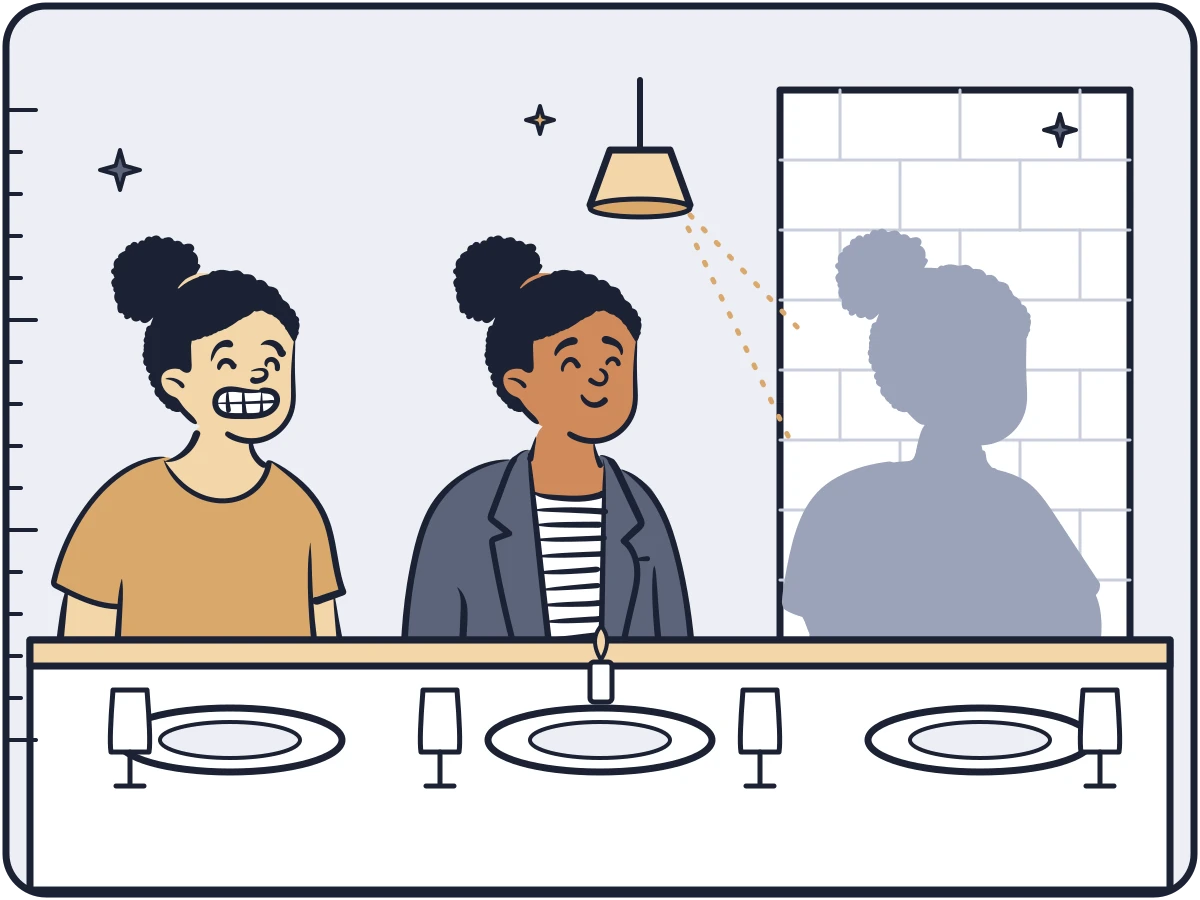
Noor, 26, is at her team’s end-of-quarter dinner. She laughs at the right moments, remembers everyone’s order, and says she is “totally fine” when the booking changes. On the train home she snaps at her sister on the phone and cannot say why.
Jung would say three different things were at that table. This page sets the ego, the persona and the shadow side by side, with his own definitions and paragraph numbers, and then walks through Noor’s evening. If you would like to see how you describe yourself first, the test takes about 6 minutes, with no sign-up.
What is the difference between persona, shadow and ego?
Here is the whole comparison in one place. The wording in the cells is our plain-English summary of Jung, and each row carries the paragraph numbers to check. The “Where it sits” row for the persona is our reading, since Jung describes it by its job rather than its location.
| Ego | Persona | Shadow | Self (briefly) | |
|---|---|---|---|---|
| Jung's words | The complex factor to which all conscious contents are related (CW 9ii §1) | A complicated system of relations between you and society, a kind of mask (CW 7 §305) | The negative side of the personality, plus underdeveloped abilities (CW 7 §103, note 5; CW 9ii §13) | The total personality, which cannot be fully known (CW 9ii §9) |
| Where it sits | Conscious | Between you and other people, mostly in view | Unconscious (the personal unconscious) | Conscious and unconscious together |
| What it does | Says “I”, chooses and adapts by will (CW 9ii §11) | Makes an impression and keeps the rest out of sight (CW 7 §305) | Holds what the ego does not own, mostly inferior but not only (CW 9ii §13) | Contains the ego as a part of a whole (CW 9ii §9) |
| How you notice it | You can describe it: your name, plans, what you think you are like | Your tone changes with the audience and you feel “on” | A reaction bigger than the facts, plus certainty about someone else (CW 9ii §16) | Not directly; Jung says we can hardly picture it (CW 7 §274) |
| When it goes wrong | It takes itself for the whole of you, or swells (CW 9ii §§11, 44) | You believe you are the role (CW 7 §306) | It is pushed onto other people and gets denser the less you admit it (CW 11 §131) | It is mistaken for the ego or for a hidden perfect you |
If you read down a column you get one part. If you read across a row you see the same question asked of each, and that is the quickest way to stop mixing them up. The next sections take them one at a time, then together.
What do all three look like at one work dinner?
Back to Noor. This is our worked example and not a case of Jung’s. Each step names the part that is at work.
- Ego. Noor decides to go, picks the seat next to her manager, and says “fine” when the booking changes. This is the part that chooses, and Jung called the ego the subject of all attempts at adaptation that are achieved by will (CW 9ii §11).
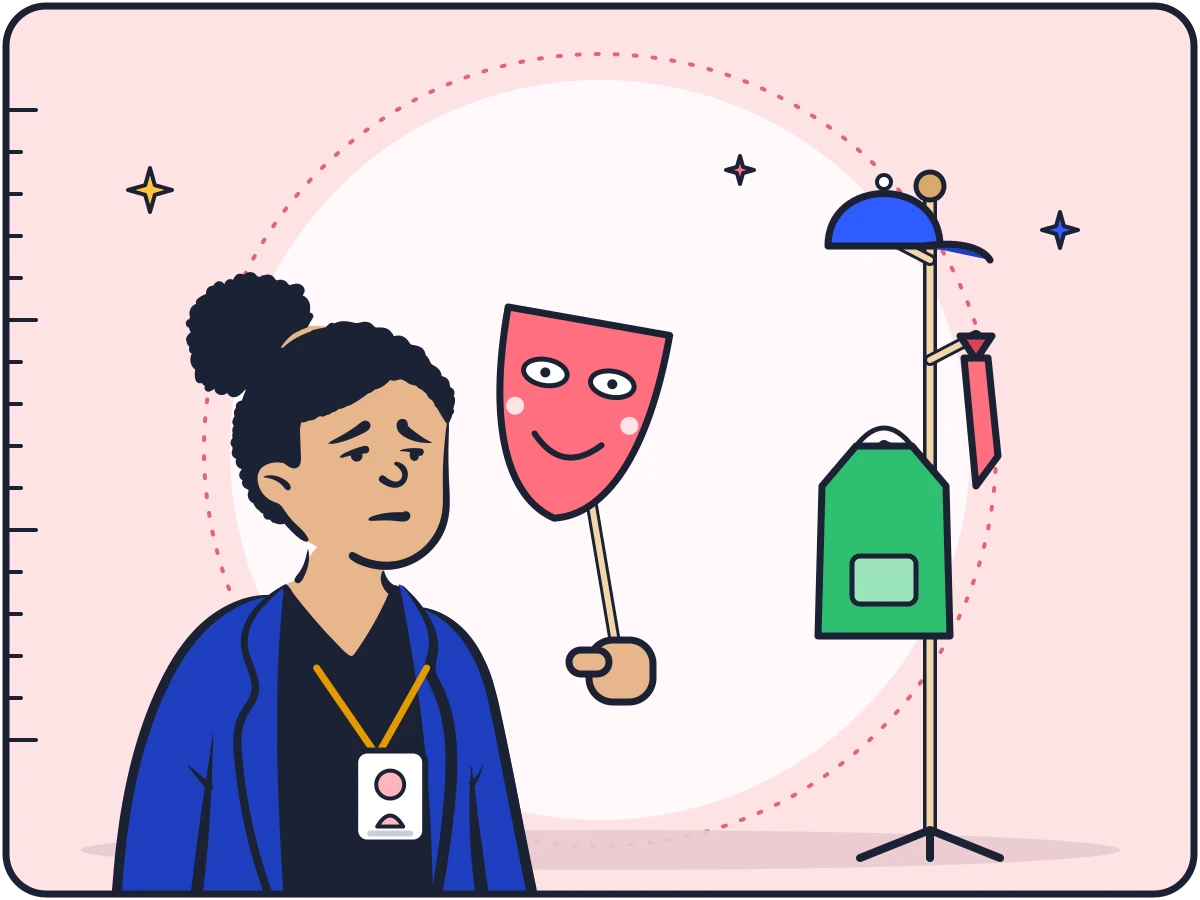
- Persona. The warm, agreeable voice is the role. It is built from what a team expects of a reliable colleague, and it is useful. Jung wrote that society expects each person to play the part assigned to them (CW 7 §305).
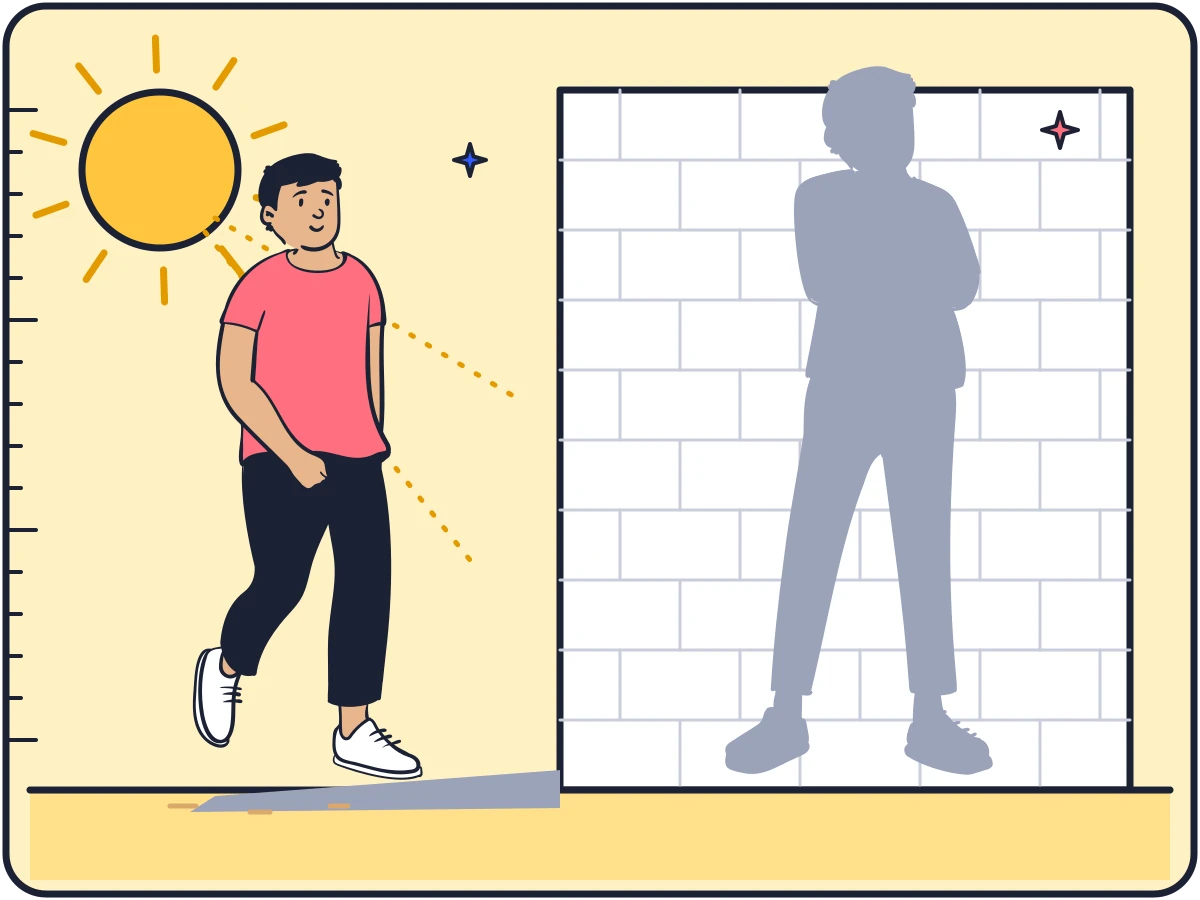
- Shadow. What the role has no room for is the part of Noor that minded the change, wanted to be asked, and is a little impatient. It may also be an ability she never developed, which is a plain “no”. Jung’s definition covers both the unpleasant qualities and the underdeveloped functions (CW 7 §103, note 5).
- The phone call. Her sister says she sounds irritable, and Noor is sure the sister is the difficult one. A strong reaction plus certainty about the other person is the pattern Jung described for projection (CW 9ii §16).
Notice that nothing here is a flaw. The role did its job, the “I” made a reasonable choice, and the leftover came out sideways at someone safe. Jung’s own remark about the price of a polished persona is the same shape: whoever builds up too good a persona pays for it with irritability (CW 7 §306).
For the mask on its own, see Jung’s persona. For the leftover on its own, see the shadow, and for how the leftover lands on other people, projection.
Is the ego the same as being arrogant?
No. In everyday speech “ego” means pride, as in “he has a big ego”. Jung used it for something plainer: the part of you that is aware.
“constitutes the centre of my field of consciousness”
That is the definition from his glossary in 1921. He added that the ego is not the whole psyche but “merely one complex among other complexes” (CW 6 §706). A complex, in his sense, is a group of ideas and feelings that hang together, and the ego is the one that you are looking out from.
He also made the ego smaller than we like to think. In Aion he wrote that the ego is never more and never less than consciousness as a whole (CW 9ii §7), and that it is part of the personality but not the whole of it (CW 9ii §11). The most decisive qualities in a person, he added, are often unconscious and can be perceived only by others (CW 9ii §7).
The “big ego” meaning does exist in Jung, but under another name, which is inflation (a swelling of the self-image, up or down). It gets its own page: ego inflation.
How do the three push on each other?
They are not three boxes. Jung describes forces between them, and three are worth knowing.
- Ego and persona. The risk is identification. He wrote that building a persona that suits everyone is a concession to the outer world that drives the ego straight into identification with it (CW 7 §306). The test of this is whether you can say that your role and you are two things.
- Persona and shadow. The better the mask fits, the more is left out of it. Jung described the left-out part coming back as moods and irritability (CW 7 §§306-308) and, for very moral people, “hellish moods” (CW 11 §130).
- Ego and shadow. The ego is the one that has to do the noticing. Jung called this a moral problem for the whole ego-personality, because it takes admitting that the dark aspects are present and real (CW 9ii §14). He thought the shadow could be assimilated into the conscious personality to some extent, while some features resist (CW 9ii §16).
Notice what is missing: any move that makes the shadow disappear, or the persona. Jung’s tone is closer to “know what is what” than to “fix yourself”. That is also why the persona is not the enemy. The point is to stay in touch with who is wearing it.
How can you tell which one is acting in your own week?
These are prompts, not measurements. They come from the table above, and each is something you could check with a friend.
- Ask who is talking. If you can say “that was my work voice”, you are in persona territory and you know it. If you cannot find the seam, it may have become the only voice you have.
- Ask who would describe it better. If a friend can name something about you that you cannot, it may live in the shadow. Jung’s point in Aion is that others often see it first (CW 9ii §7).
- Ask where the charge is. A reaction bigger than the facts, with certainty about the other person, points at a projection (CW 9ii §16). It is a hint to check against real moments, not a verdict.
- Ask what you decided. A choice you can explain and own is the ego working. A choice that “just happened” deserves a second look.
If something here feels heavy or keeps coming back, a professional is the right person to talk it through with. This site is a reflection tool, not therapy.
Where does the self fit among the three?
Jung drew a bigger circle around all of them. He called the total personality, conscious and unconscious together, the self, and said the ego is related to it like a part to the whole (CW 9ii §9).
He also noted a telling difference between the persona and the self. We can see ourselves as a persona without much trouble, but it is beyond our powers of imagination to form a clear picture of what we are as a self (CW 7 §274).
That is why this page keeps the self to a short column. It is Jung’s construct for what none of the other three can see, and it has its own page: the self and the ego.
What do pop pages get wrong about these three?
| The popular claim | What Jung wrote |
|---|---|
| "Ego means arrogance" | The ego is the centre of the field of consciousness (CW 6 §706). Pride has its own term, inflation (CW 7 §227). |
| "The persona is your fake self" | It is a necessary role, and it is a compromise with society (CW 7 §305 and §246). The danger is believing it is all of you (CW 7 §306). |
| "The shadow is your evil side" | He said it is made of inferior and undeveloped qualities, and that in rare cases it is the positive qualities that are repressed (CW 9ii §13). |
| "Integrate the shadow and you are done" | He wrote that it can be assimilated “to some extent”, and that some features resist (CW 9ii §16). |
| "Jung's three are Freud's id, ego and superego" | Different maps. This one has no id and no superego, and it defines the ego by consciousness (CW 9ii §1). |
The test on this site does not measure any of the three. It reads how you describe yourself in a few everyday scenes and ranks Jung’s four functions, which is a different thing. If you want to see what it can and cannot do, read the method.
Questions people ask
Is the shadow conscious or unconscious?
Unconscious, by Jung’s definition, which is why it surprises people. He called the personal unconscious a layer that corresponds to the figure of the shadow often met in dreams (CW 7 §103). Parts of it can become conscious with effort (CW 9ii §14).
Is the persona conscious?
Mostly, until you identify with it. At that point you stop noticing that you are playing a role, which is the trap Jung warned about (CW 7 §306).
Can the shadow and persona be the same thing?
No. They are complementary. The persona is what you show, and the shadow is what the persona leaves out.
Which one is the real me?
Jung would say none of the three on its own. The nearest thing to “all of you” in his system is the self, and he thought it could never be fully known (CW 9ii §9).
Sources
- C. G. Jung, Psychological Types (Collected Works vol. 6, Hull translation), Definitions, “Ego”, §706
- C. G. Jung, Two Essays on Analytical Psychology (CW 7), §103 and note 5; “The Relations between the Ego and the Unconscious”, §§227, 246, 274, 305-308
- C. G. Jung, Aion (CW 9 part 2), chapter 1 “The Ego”, §§1-12; chapter 2 “The Shadow”, §§13-19, and chapter 4 “The Self”, §44
- C. G. Jung, Psychology and Religion: West and East (CW 11), “Psychology and Religion”, §§130-131