Jung's Persona: Why the Mask Is Not Fake, and When It Becomes a Trap
The role you play for other people, and the one thing Jung said goes wrong with it
9 min read · Updated 27 November 2026

Most pages about the persona tell you to take your mask off. Jung did not. He wrote that society expects every person to play a part, and that building one is unavoidable. What he warned about is something quieter: forgetting that it is a part.
This page walks through what he actually wrote, with paragraph numbers from his Collected Works. It covers why the persona is not fake, the sign that you have fused with yours, what he said happens when the role breaks, and what that looks like at 24 with a first job and a LinkedIn profile. If you would like to see how you describe your own role, the test has a scene for it.
What is the persona in Jung's psychology?
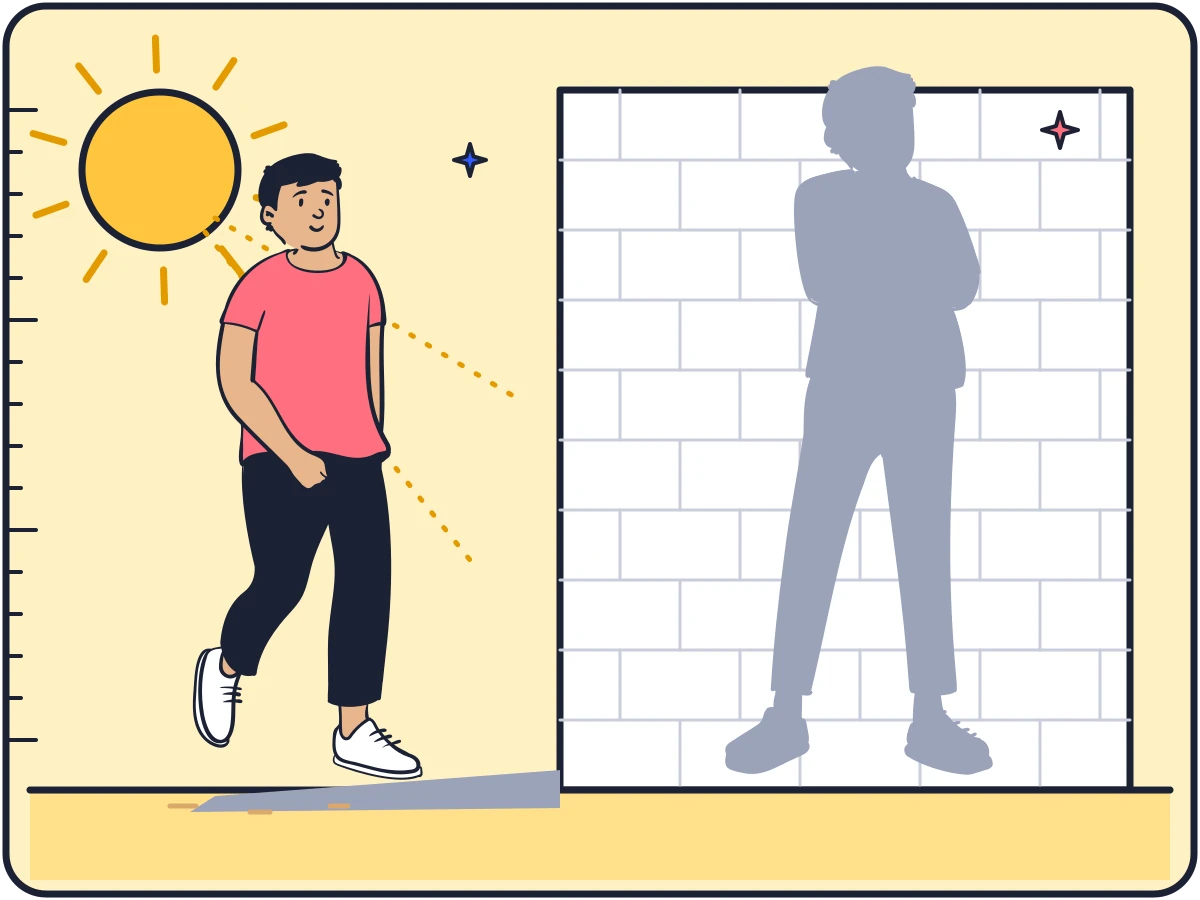
The persona is the face you show the world: the role you play for other people, built from what your family, school, job and friends expect. Jung took the word from Latin, where it meant the mask an actor wore on stage.
His definition is blunt. It is a system of relations between you and society, designed to make a certain impression on others and, as he adds, to keep the real you out of sight.
“fittingly enough a kind of mask”
In another passage he calls it a compromise between the individual and society about what a person should seem to be (CW 7 §246). So the persona is not a lie you tell. It is a negotiated settlement.
There is an odd twist in his account. Jung said the conscious personality we think of as “me” is partly an arbitrary segment of the collective psyche, which is his phrase for what we all share as human beings. When you examine a persona, what looked personal turns out to be mostly collective, taken from the common supply of roles (CW 7 §§244-246).
He still left room for you. He added that there is something individual in the peculiar choice and shaping of the persona (CW 7 §247). Two people in the same job do not play it the same way.
Is the persona fake, and do you need one?
Jung’s answer is that you need one, and that the advice to drop it comes from the wrong place. He wrote that society expects, and has to expect, every person to play the part assigned to them.
“Society expects, and indeed must expect, every individual to play the part assigned to him”
He goes further. Anyone who claims the concealing function of the persona is unnecessary, he said, can only do so if they are so identified with their persona that they no longer know themselves. The person who says “I never put on an act” is often the one most stuck in a role.
Think of how you talk to a manager, to your sister, and to a friend at midnight. Each is a different tone, vocabulary and level of detail. None of them is a lie. You are fitting the person in front of you, and that is a social skill.
In Jung’s terms, a tidy, well-built persona lets you work and live around other people without exposing every raw nerve at every meeting. The trouble starts elsewhere.
When does the persona become a trap?
The word Jung uses is identification: you stop wearing the role and start being it. He wrote that there really are people who believe they are what they pretend to be.
“people really do exist who believe they are what they pretend to be”
In his book on types he draws the same line between a “personal” person, who identifies with the mask, and an “individual” one (CW 6 §800). In his view that has a cost: anyone who is himself his outward role will be defenceless against what goes on inside (CW 6 §807). The role leaves no room for anything it did not plan for.
He names two signs.
- Touchiness. People who are purely their role are very sensitive, because something could easily happen that exposes a side they do not want to see (CW 7 §244).
- Private irritability. Whoever builds too good a persona pays for it with bad temper, which Jung puts as “the vice of the virtuous” (CW 7 §306). The social strong man is often, he said, a child about his own feelings (CW 7 §307).
Jung’s examples include the humourless way some people identify with their business or their title, which he sums up as “L’etat c’est moi”, “I am the state” (CW 7 §227). The modern version is the person for whom a job title is the answer to “who are you?”, and for whom a performance review feels like an attack on their existence.
In his own era he told it mostly with male examples, but the mechanism is not specific to any gender. Anyone who has been the reliable one, the clever one or the easy one for years can recognise it.
What happens when the persona cracks?
Roles break. You are laid off, a relationship ends, a plan collapses, a feedback meeting goes badly. Jung described three reactions, and only one he called good (CW 7 §§254-266).
Take Priya, 24, who has built her identity on being the star junior at an agency. She is told her contract will not be renewed. Here are the three paths in her situation.
Shrink back
Jung called this the regressive restoration of the persona. Priya takes any job below her level, stops taking risks, and builds a smaller, safer version of the role. His own example is a businessman who loses everything and ends up in a post far below his abilities, with the mentality of a scared child (CW 7 §254).
He added a twist. This course can be right for a person whose failure came from inflating themselves. In other cases, he said, resignation and self-belittlement are an evasion (CW 7 §259).
Swell into a cause
The second path is to join something bigger so that you do not have to face the gap. Priya decides the industry is rotten, and she is now a prophet of how work should be done. Jung called this identification with the collective psyche: inflation (a swelling of the self-image, in our plain words) turned into a system (CW 7 §260).
Look at it
The third path is what he called “critical understanding” (CW 7 §254). Priya asks which parts of the role were hers and which were borrowed, which of her reactions came from fear, and what she would still want if nobody was watching. Jung also named a larger destination beyond the two bad options, which he called individuation (CW 7 §266). That is a separate topic, and the individuation article explains why he did not offer it as a programme.
Jung’s own examples are dramatic. For an ordinary person, the same three paths show up after a bad review or a lost friendship. They are worth recognising, because the first two feel like solutions.
How are the persona and the shadow connected?
They are partners. The persona is what you show, and the shadow is what the persona leaves out. The tighter the role, the more has to be kept out of it.
Jung noted that an outwardly strong persona is paid for inwardly. An absence of resistance to the pull of the persona means a similar weakness against the influence of the unconscious (CW 7 §308). In plain terms, a person who always “keeps it together” at work is often the one with the strange, outsized moods at home.
His line about very moral people, who unaware of their other side develop “hellish moods” (CW 11 §130), is the same point. The shadow article picks up from there.
He also gave a simple test of whether you can tell the difference. It is easy enough to make it clear to someone that they and their office are two different things (CW 7 §310). If that sentence stings, you may be closer to identification than you think.
What does a persona look like at 24?
Jung wrote in a world of offices, clergy and uniforms, and the idea travels well. The persona is any role, so it shows up in several places at once.
- First job. The “always positive” version of you that you bring to the team. It is useful, and it can become the only one allowed.
- LinkedIn and Instagram. A public page is a persona made visible. It is a curated surface, so it is no more fake than a business suit. The risk is the one Jung named: starting to believe the profile is the whole of you.
- The group chat. The funny one, the reliable one, the one who never complains. Roles in a friend group set early can stay long after they stop fitting.
The sociologist Erving Goffman reached a parallel view from a different direction in The Presentation of Self in Everyday Life, arguing that everyday behaviour is a kind of performance for an audience. Jung’s addition is the warning about what happens inside the performer.
A note on terms. Online, “masking” is also used in other fields with meanings of their own. This article uses “mask” only in Jung’s sense of the persona.
Role or self? Eight questions
None of these has a score. They are prompts to check against real moments of your own week, in the spirit of Jung’s distinction between what you are and how you appear to yourself and others (CW 7 §310).
- Can you say “that is my job, not all of me” and mean it?
- When someone criticises your work, does it feel like an attack on you?
- Are you noticeably different at home, tired and short-tempered, after a day of being “on”?
- Can you say “I don’t know” at work without a flinch?
- Do you judge people harshly when they slip out of the role you hold yourself to?
- If you lost the title tomorrow, could you describe yourself without it?
- When you say “I should”, whose voice is it, yours or the role’s?
- Can you tolerate being seen as ordinary for an afternoon?
More “no” answers than you expected is not a diagnosis. It tells you where the role and the person are glued together, which is the thing Jung pointed at.
The test on this site does not measure your persona. It reads how you describe yourself in short scenes, including one about how tightly a role sticks to you. That is a prompt to check against real moments (see the method), and it does not tell you what is under the mask.
Questions people ask
What is the difference between the persona and the ego?
The ego is the centre of your field of awareness, which Jung called one complex among others and not the whole of the psyche (CW 6 §706). The persona is a role the ego wears. You can lose track of the difference, which is the point of the identification warning above.
Is the persona my true self?
No, and the “true self” in the popular sense is not Jung’s idea either. His word “self” means the whole personality, including parts you do not know yet (CW 6 §789). It is not a hidden perfect you under the mask.
Is a social media profile a persona?
It is one expression of it. Jung’s persona is any social role, and a profile makes yours visible. Whether it is a trap depends on whether you can step away from it.
Can you drop the persona?
Not completely, and Jung did not advise it (CW 7 §305). What he described as the aim of individuation is to divest the self of the false wrappings of the persona (CW 7 §269). That means the false parts, not all of it, and the process is not one he recommended for everyone.
Does a strong persona mean a shallow person?
Jung did not say that. His concern is identification, not quality. A skilled, polished professional who knows they are playing a part is not in the trap he described.
Sources
- C. G. Jung, Two Essays on Analytical Psychology (Collected Works vol. 7, Hull translation), “The Relations between the Ego and the Unconscious”, §§227, 244-247, 254-266, 269, 305-310
- C. G. Jung, Psychological Types (CW 6), definition of “Persona”, §§800, 807; ego, §706; self, §789
- C. G. Jung, Psychology and Religion: West and East (CW 11), §130
- Erving Goffman, The Presentation of Self in Everyday Life (1956; Doubleday edition 1959)