What Is the Shadow Self? Jung's Idea, in His Own Words
The part of you that you do not recognise as yours, and the lines about it that Jung never wrote
10 min read · Updated 27 November 2026
Search for the shadow self and you will find two different things. One is a trending idea about your dark side and how to confront it. The other is a small, careful idea in Carl Jung’s writing about the parts of yourself that you do not recognise as yours.
This page sticks to the second. It sets out what Jung wrote, with paragraph numbers from his Collected Works, how people tend to meet their shadow (usually through someone who annoys them), and which famous lines are not his. It also says plainly what a self-reflection test can and cannot do here, which is less than most pages on this topic promise.
What is the shadow in Jung's psychology?
The shadow is the part of your own personality that you do not see or do not accept. It is made mostly of traits you would rather not own, and of abilities you never got around to developing. Jung used “the unconscious” for whatever you are not aware of but that still shapes how you act, and the shadow lives there.
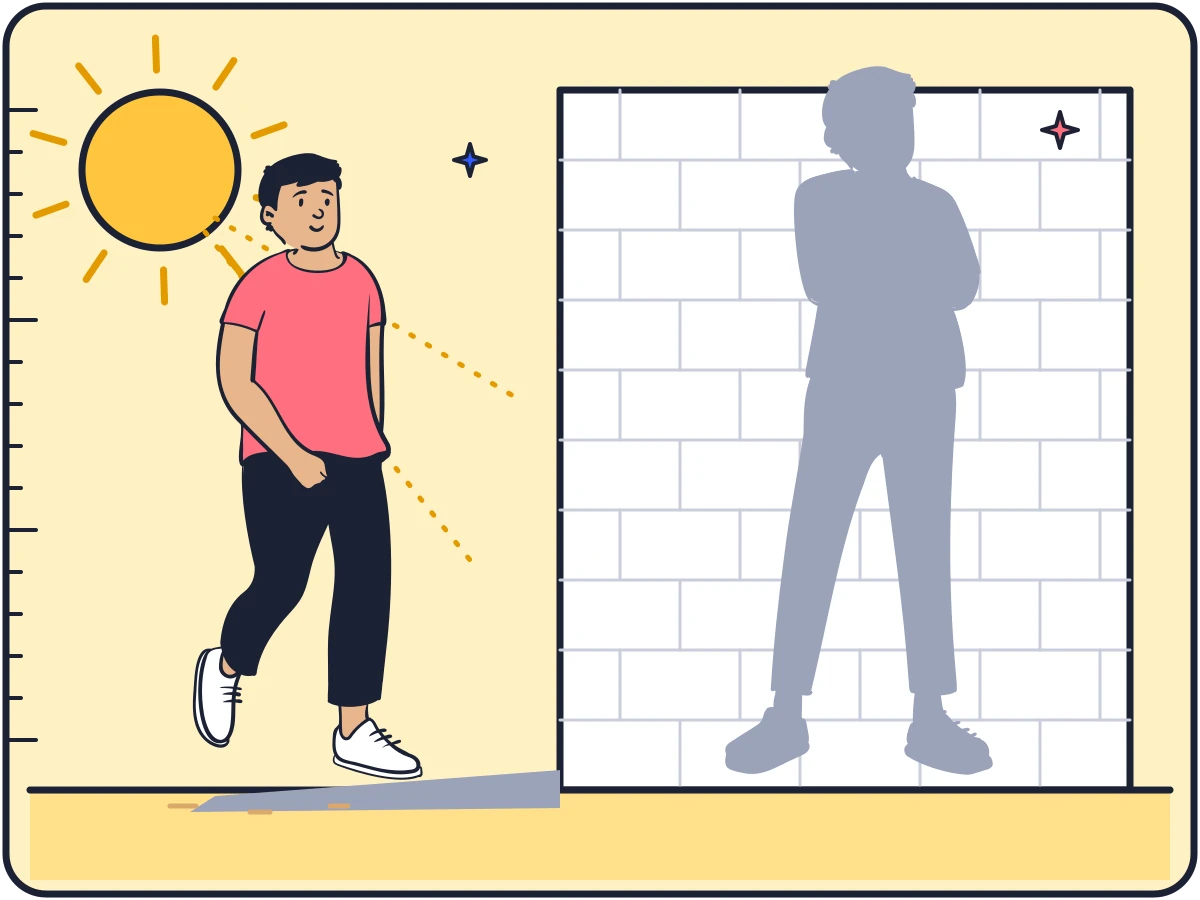
Think of it as a picture. You face the light, and wherever you stand you throw a shadow behind you. You cannot see it by looking ahead, and other people often see it before you do.
Jung called the shadow a moral problem, because seeing it means admitting something about yourself that you would prefer not to admit.
“no one can become conscious of the shadow without considerable moral effort”
He counted the shadow among the inner figures with the most disturbing influence on the ego, the part of you that says “I”. He also called it the most accessible of them (CW 9ii §13), and the first one you meet (CW 9ii §42). In a later passage he called meeting it an “apprentice-piece”, the first piece of work before harder ones (CW 9i §61).
Is the shadow your evil side?
No. This is the most common mistake, and Jung argued against it directly. If the hidden tendencies were obviously evil, he said, there would be no problem at all.
“merely somewhat inferior, primitive, unadapted, and awkward; not wholly bad”
He was not saying everything is fine. He wrote that people are less good than they imagine, and that everyone carries a shadow (CW 11 §131). The less you let it into your conscious life, the denser it gets.
He also wrote that the shadow is not only the unpleasant stuff. It can hold qualities he listed as good: normal instincts, appropriate reactions, realistic insights and creative impulses (CW 9ii §423). In rare cases the positive qualities are the ones being repressed (CW 9ii §13).
A concrete case. Sam was raised to be modest and never to push himself forward. As an adult he cannot say “I want that promotion” out loud. Ambition is not a dark trait, but for Sam it has ended up in the shadow, because he never allowed himself a version of it.
Jung also rejected the idea that the answer is to push the shadow down harder. He compared mere suppression to a bad cure.
“as little of a remedy as beheading would be for headache”
Nor did he say that you should act out whatever it contains. His own word for the task is recognition, and he called it effortful.
How do you actually meet your shadow?
Mostly you do not meet it directly. You meet it through projection, which means seeing in another person a trait that is really yours, without knowing it. Jung put it this way: it is the unconscious that does the projecting, not you.
“one meets with projections, one does not make them”
Here is a scene. Maya, 24, sits in a team meeting while her colleague Dan talks over people, claims credit and says he is “just being honest”. She is furious for the rest of the day. Her friends think he is a bit much, but not that much.
Three signs, in order, are worth noticing. They are our reading of Jung’s description, not a checklist from him.
- Charge. The reaction is stronger than the facts. You are still angry hours later, or you rehearse what you should have said.
- Certainty. You are sure what kind of person he is, and you feel you do not need to look further. Jung noted that the cause seems to lie, beyond all possibility of doubt, in the other person (CW 9ii §16).
- A trait that is quietly yours. Maybe Maya has also wanted the credit, or wanted to speak without checking everyone’s face first. She has simply never allowed herself to take it that way.
Notice the wording: “maybe”. Not every irritation is projection. Dan might really be a poor colleague.
Jung’s claim is narrower than the internet’s. A strong emotional reaction, plus certainty, is a hint worth checking against real moments, and it is not a verdict.
Projection also runs the other way. Jung’s 1921 definition says people project not only painful contents but also positive values that, for one reason or another, they cannot reach (CW 6 §783). If you feel an almost fierce admiration or envy for someone, that can point at something you have left unlived. Later writers gave this idea its own name, which we come to below.
“Projections change the world into the replica of one’s own unknown face”
Jung’s modest remedy was the withdrawal of projections. He wrote that nothing promotes understanding between people more than this, and that it demands self-criticism (CW 10 §577).
Are there different kinds of shadow?
Yes, and Jung was careful to separate them. The distinction matters because the pop version treats the shadow as one thing you can look at on a Sunday afternoon.
- Personal shadow. Your own disowned traits and undeveloped abilities. Jung said you can see through this one “with a little self-criticism” (CW 9ii §19).
- Collective shadow. What a group or a society will not admit about itself and pushes onto an outsider. Jung described how a side convinced it was entirely in the right projects all wrongdoing onto the other side (CW 10 §409), and he noted that we too are capable of all that humans can do (CW 10 §412).
- Archetypal shadow. Jung’s term for evil that is felt as bigger than any one person. He said that facing it is “rare and shattering” and as hard as the later stages of his scheme (CW 9ii §19).
Everything an everyday article can help with sits in the first kind. The other two are real parts of his theory, but they are not something to try on yourself from a blog post. Where the line sits is also why Jung wrote that recognising the shadow leads to the modesty we need (CW 10 §579), not to dramatic self-discovery.
How are the shadow and the persona connected?
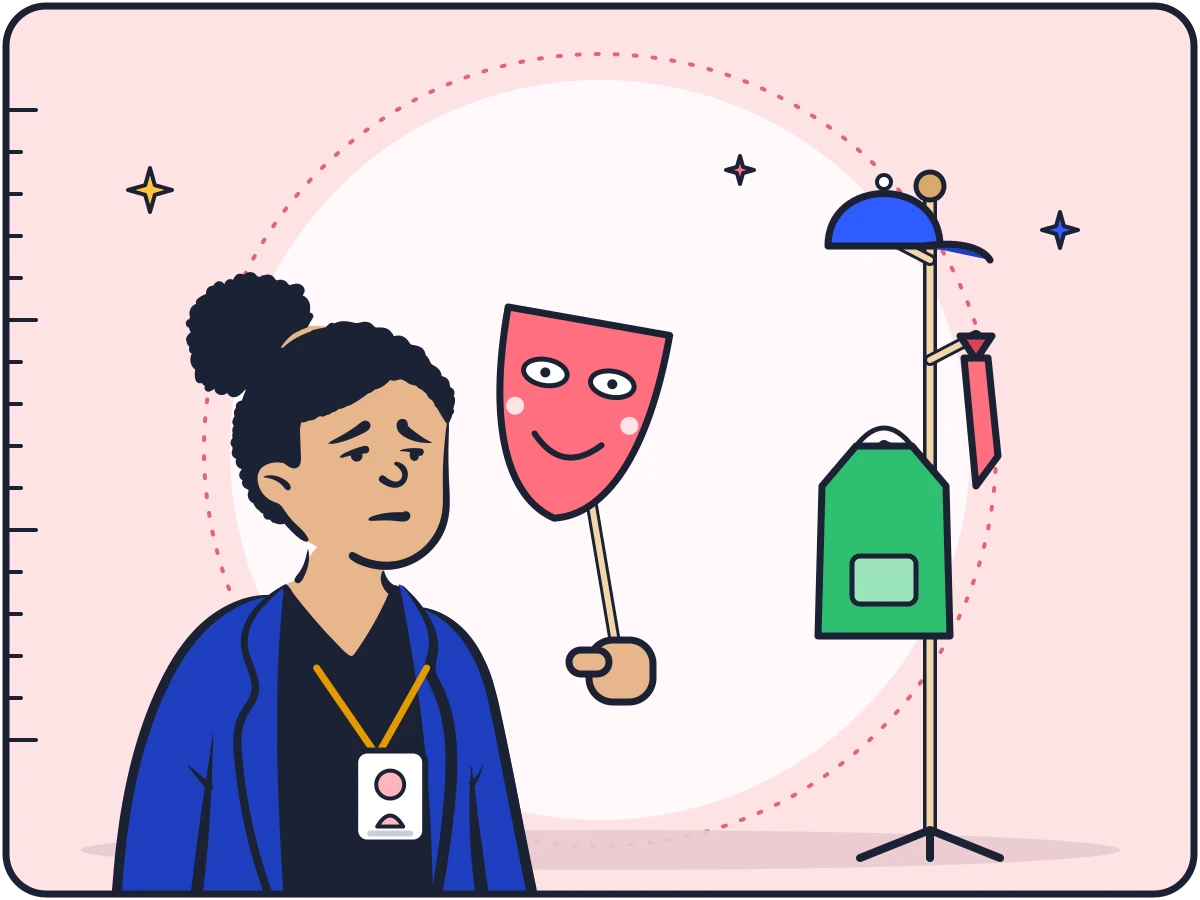
The persona is the role you play for other people: the reliable colleague, the easygoing friend, the good daughter. The shadow is what that role has no room for. The more polished the role, the more material ends up in the shadow.
Jung’s example is people who are very moral and unaware of their other side. He said they develop moods that make them hard to live with.
“hellish moods which make them insupportable to their relatives”
That fits with his dry comment in the Two Essays that whoever builds too good a persona pays for it with irritability (CW 7 §306). If you want the other half of this pair, the persona article covers the mask and what happens when it cracks.
Is "shadow work" what Jung meant?
“Shadow work” is the name of a large online trend: journal prompts, videos, workshops, checklists. In this article it is only a name for that trend. We do not offer it, and the test on this site is not shadow work.
Jung’s own texts name a task, which is recognition. You admit the dark or inferior qualities are present and real (CW 9ii §14). With insight and good will he thought the shadow could be assimilated into the conscious personality to some extent, while some features resist moral control (CW 9ii §16).
What the texts do not contain is a worksheet. He wrote that mere self-observation and intellectual self-analysis are entirely inadequate for real contact with the unconscious (CW 8 §165). He also warned that a freed unconscious can overwhelm the ego (CW 8 §183). That is one reason we ask for nothing deeper than noticing, as described below.
Modern Jungian writing is cautious too. An article on the shadow for the International Association for Analytical Psychology says the shadow holds both positive and negative qualities, that it “can only be partially known”, and that the ego can be captured by it. Roger Bretherton, a psychology professor writing in The Conversation in 2023, warns that the trouble comes when powerful emotions take us over, and that people then need friends or a good therapist.
So the honest answer is: partly. The idea of facing what you disown is Jung’s. The idea that this is a project with prompts and an end date is not.
Which famous shadow lines are not Jung's?
A lot of shadow content leans on quotes that are misattributed or simplified. When a line is wrong or cannot be traced, we say so rather than use it.
| The popular line | What we found |
|---|---|
| "The shadow is your dark or evil side" | Jung says it is mostly inferior and undeveloped, “not wholly bad” (CW 11 §134), and can hold good qualities (CW 9ii §423). |
| "Everything that irritates you about others is your shadow" | The line usually quoted says irritation “can lead” to understanding ourselves. It is credited to Memories, Dreams, Reflections (1963); we could not check the page, so we do not quote it. In the Collected Works the claim is narrower: a strong reaction with certainty about the other person (CW 9ii §16). |
| "The golden shadow, as Jung called it" | We searched the main volumes (CW 6, 7, 8, 9i, 9ii) and did not find the phrase. The idea that the shadow holds good qualities is Jung’s (CW 9ii §423). The label came from later writers. |
| "90% of the shadow is pure gold" | No source found. Bretherton writes only that it is “apparently” Jung’s. We do not use it. |
| "Shadow work is something you finish" | The IAAP article says the shadow can only be partially known. |
| "Your shadow self" | Jung writes “the shadow”. “Shadow self” is the common modern phrasing; we did not find it as his term. |
Can a test show you your shadow?
No, and Jung gives the reason himself. In The Undiscovered Self he writes that what most people call self-knowledge is the ego’s knowledge of itself, and that self-knowledge cannot rest on theory.
“There is and can be no self-knowledge based on theoretical assumptions”
A questionnaire is an instrument for the ego. It can show how you describe yourself, and it cannot reach what you do not know about yourself. So this site’s test does not find your shadow, and a result that claimed to would be making something up.
What the test does show is a ranking of Jung’s four functions, thinking, feeling, sensation and intuition, from the choices you make in short everyday scenes. The one opposite your lead is shown as a quality you may not have lived much yet. Jung came close to equating that least-used function with the dark side of the personality (CW 9i §222), but the shadow is wider, so we keep them apart. Our inferior function article covers that function, and the method page explains how scoring works.
If you want something to do with this, here are three things to notice, with no digging into memories required.
- The next time a reaction is stronger than the facts, write down what happened in two plain sentences, then what you felt. Look at the gap.
- Name one person you admire a little too fiercely. Ask what quality it is, and whether you have allowed yourself any small version of it.
- Listen for “I would never” in your own sentences, and ask a friend who knows you whether it is true.
Check what you notice against real moments and real people.
That matches Jung’s own condition: withdrawing a projection demands self-criticism (CW 10 §577). If a reaction feels heavy or keeps returning, a professional is the right person to talk to. This site is a reflection tool and not therapy. For what we deliberately leave out, see where Jung stops.
Questions people ask
What is the difference between the shadow and the ego?
The ego is the part of you that says “I”: what you know about yourself and identify with. The shadow is what the ego does not recognise as its own. They are two sides of one personality, not two people.
Is projection always about the shadow?
No. Projection can carry admiration as well as dislike (CW 6 §783). And sometimes the person really is the problem. Jung’s point is only that a strong, certain reaction is worth checking.
Can you get rid of the shadow?
Jung did not think so, and did not suggest it. His aim was to know it better, since the less it is part of conscious life the “blacker and denser” it gets (CW 11 §131). The IAAP article adds that full integration is not possible either.
Where does the shadow fit in becoming more yourself?
Jung put it first in a long sequence, but he also said that sequence is not for everyone. The individuation article covers that, including why he did not offer it as self-improvement.
Sources
- C. G. Jung, Aion (Collected Works vol. 9 part 2, Hull translation), chapter 2 “The Shadow”, §§13-19, 42, 423
- C. G. Jung, Psychology and Religion: West and East (CW 11), “Psychology and Religion”, §§130-134
- C. G. Jung, Psychological Types (CW 6), definition of “Projection”, §783
- C. G. Jung, Two Essays on Analytical Psychology (CW 7), §306
- C. G. Jung, The Structure and Dynamics of the Psyche (CW 8), “The Transcendent Function”, §§165, 183
- C. G. Jung, The Archetypes and the Collective Unconscious (CW 9 part 1), §§61, 222, 513
- C. G. Jung, Civilization in Transition (CW 10), “After the Catastrophe” §§409, 412 and “The Undiscovered Self” §§495, 577, 579
- Natalia Serebrennikova, “The Shadow”, short articles on analytical psychology, International Association for Analytical Psychology
- Roger Bretherton, “Shadow work: why you should be cautious of the TikTok self-help trend”, The Conversation, 10 October 2023