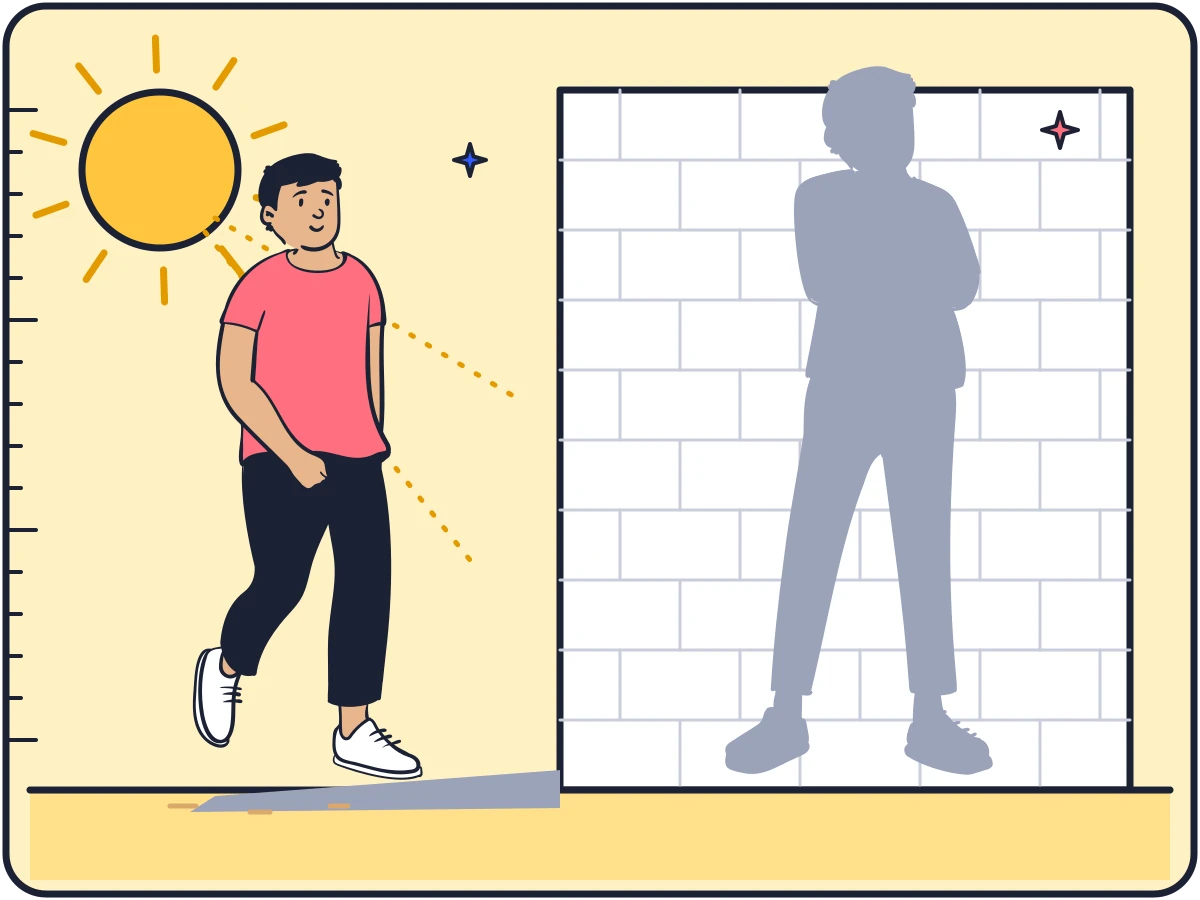
Jung's inferior function: the part of you that takes over when you are worn out
What Jung wrote about your least-used side, why it flares under strain, and what he said you can do
8 min read · Updated 27 November 2026
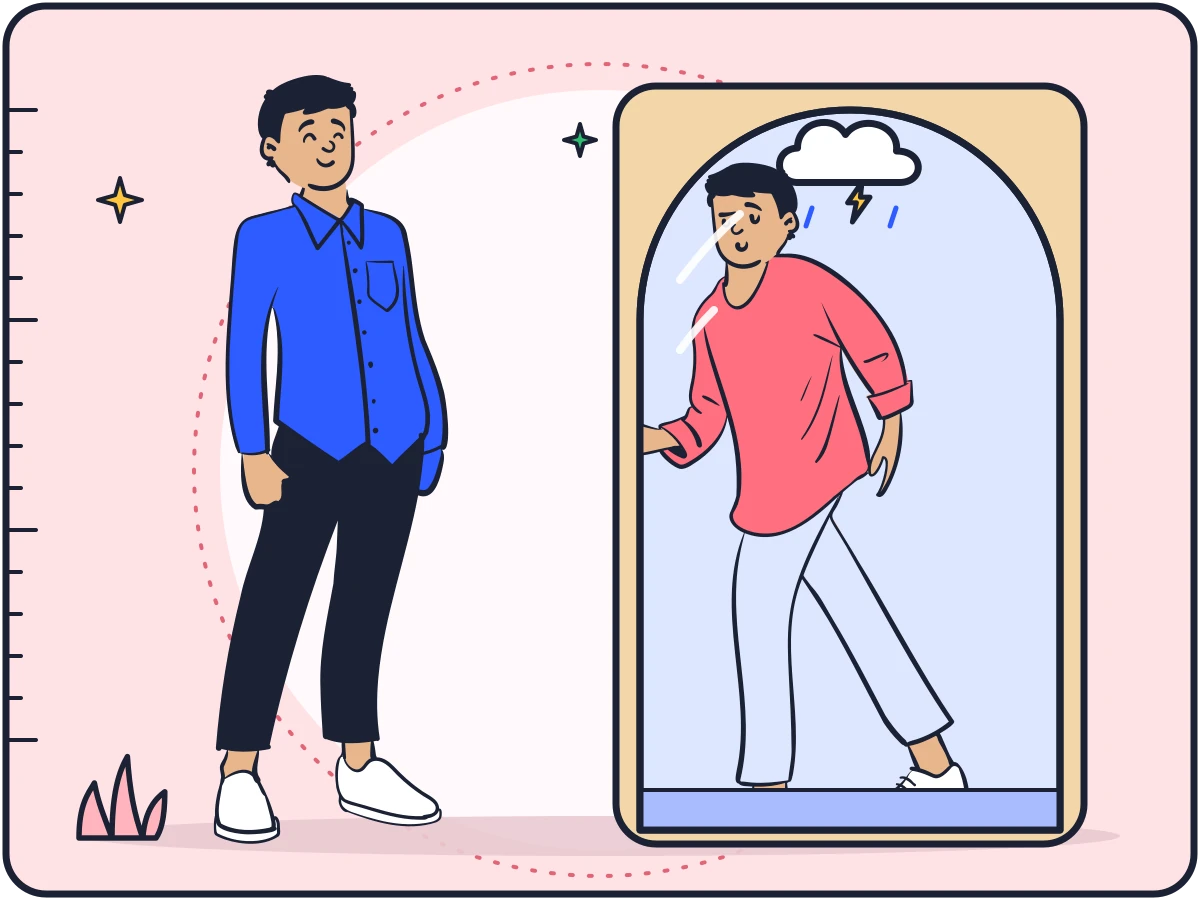
You know the person who is calm and precise all week, then snaps at a friend over a small thing late on a Friday. Or the warm, easy colleague who suddenly delivers a blunt opinion that lands like a brick. Jung noticed the same pattern in his patients and gave it a name: the inferior function.
It is easy to find a dozen pop-psychology pages about it. This one sticks to what Jung wrote, with paragraph numbers, and translates it into scenes you can check against your own bad weeks. If you want to see how you describe yours, the test takes about 6 minutes, with no sign-up and a free result.
What is the inferior function?
Jung described four basic functions, or habitual ways of working: sensation, thinking, feeling and intuition. If you need a refresher, start with the four functions in plain English. Most people, he said, develop one of them far more than the others.
The inferior function is the one opposite your strongest. If you lead with thinking, it is feeling. If you lead with intuition, it is sensation, and so on around the cross.
Jung said it arises because a person identifies more and more with the function that works best (CW 6 §763). The more you rely on it, the more the opposite one is left behind. That is a matter of position, not of worth.
“inferior in a psychological but not psychopathological sense”
So “inferior” does not mean bad, broken or weak at it in a medical sense. It means the one that lags in development, and the one you cannot direct at will.
What does the inferior function look like in daily life?
Jung listed the marks of it in a single passage. It lacks self-sufficiency and depends on people and circumstances. It brings moods and crotchetiness, and it is unreliable and suggestible (CW 6 §956).
“we cannot direct it, but are rather its victims”
It also tends to arrive in a disturbing way: it intrudes on the function you use best, appears and vanishes in fits, and has something inauthentic about it (CW 6 §906). In plainer words, you do something that feels like it is not really you.
Jung’s own examples come from his eight types, and some are dated. Here is the same idea translated into four scenes. They are our paraphrase of his descriptions, not quotations.
- A person who leads with thinking (logic, structure) suddenly gets crude, moody sentimentality. Jung described the feelings of such a person as impulsive, moody and primitive (CW 6 §906). Think of the engineer who is composed all week, then weeps at a car advert and is furious at himself.
- A person who leads with feeling (what things are worth, to whom) blurts out a blunt opinion with no cushioning. Jung noted this “unsurpassable tactlessness” (CW 6 §575). Think of the kind, harmonious friend who says something blunt and cannot take it back.
- A person who leads with sensation (what is actually here) is hit by vague dread or suspicion about what could go wrong. Jung described wild suspicions and anxiety states for this person (CW 6 §608). Think of the steady, practical planner who spirals at 2 a.m. over a scenario with no evidence.
- A person who leads with intuition (what could this become) is overtaken by bodily worries or a sudden fixation on one person or object. Jung describes hypochondriac ideas and compulsive ties to particular people or objects (CW 6 §§615, 663). Think of the idea person who suddenly cannot stop checking a sore throat.
Jung gave a one-line picture of the swing: “Before dinner I am a Kantian, but after dinner a Nietzschean” (CW 6 §908). The point is that the same person can show two very different faces, depending on which function is in the driver’s seat.
Why does it take over when you are tired or pushed?
Think of the strongest function as a muscle you use all day. When you are rested, it carries the load, and the rest stays quiet. When you are worn out, or something hits a sore spot, it can fail to cope, and the other side takes the wheel.
Jung’s version is less tidy, which is why it is useful. He wrote that the inferior function has autonomy: it acts on its own, and it pulls you around until you are no longer master of yourself (CW 7 §85). He treated touchiness as a clue to where it sits.
“Sensitiveness is a sure sign of the presence of inferiority”
Note the surprise in that passage. Good events can set it off, as well as bad ones (CW 7 §85). A sudden compliment or a big win can open the door as easily as a pointed remark.
Jung also wrote that the strongest and the weakest function affect each other more than any others. The inferior one quietly and sometimes mischievously influences the lead, while the lead represses it most of all (CW 9i §431). He described it as behaving like “a teasing and distracting imp” (CW 9i §431).
Picture Dev, a thoughtful analyst. On Monday at 10 a.m. he is clear and measured. On Friday at 9 p.m., after a week of deadlines, one joke at his expense turns into a speech about how nobody here respects anyone. Same person, different function at the wheel.
Is the inferior function the same as the shadow?
They overlap, and Jung says so. In one passage he calls the inferior function “practically identical with the dark side” of personality, and calls that darkness the door into the unconscious (CW 9i §222).
But the two are not the same thing. The shadow, as he uses it elsewhere, is all the qualities a person does not recognise as theirs, including undeveloped abilities and, he said, not only bad ones (CW 11 §134). He wrote that the shadow is “not wholly bad” (CW 11 §134). The inferior function is one specific part of that picture: your weakest way of working.
Later writers in the type tradition built more on this. Popular books on the MBTI use the word “grip” for the state when the inferior function takes over. That is a later, MBTI-world vocabulary, not Jung’s, and we only mention it so you recognise it when you see it. For the shadow itself, see our page on the shadow.
Can you train the inferior function?
The common advice is to practise it, like a language. Jung was more cautious. His reasoning was that it is mostly unconscious, so you cannot will it into shape. He warned that trying to build the repressed function head-on in a heavily one-sided person is “foredoomed to failure” (CW 6 §670).
What he suggested instead is quieter. Approach it through the helper function, the second-strongest one, which sits between the two (CW 6 §670). A logical person might get at their feeling side through sensation, say, by noticing what they actually enjoy about a person or a place, instead of forcing an emotional discussion. That is our reading of his advice, not his example.
He also said that for character to develop, the other side has to be allowed to find expression (CW 7 §86). That is not an instruction to indulge every mood. It means it helps to give the neglected side some low-stakes room, and to stop being surprised when it speaks.
Jung did not think undeveloped functions were only a problem. He called them “the seminal ones” (CW 6 §907), the place where new growth tends to come from. He also noted that sometime in the course of life, the need to supplement a one-sided attitude tends to appear.
How can you spot yours this week?
You do not need to dig into anything. Just notice. Here are three observation prompts for the next seven days.
- Write down one moment when you reacted out of proportion. What was happening, and how tired or rushed were you?
- Notice what makes you touchy. Jung treated touchiness as a pointer (CW 7 §85). Which topic, tone or kind of remark gets under your skin fastest?
- Notice what you do not want to be seen doing. Crying, bluntness, planning, improvising, asking for help? The one that makes you wince is worth a second look.
Then check it against the cross. If the thing you wince at is the opposite of the way you usually work, you may have found the edge of your inferior function. If not, that is fine too. Jung’s description is a hypothesis about people in general, not a promise about you.
Our test asks about a rough week in the same spirit. It reads how you describe yourself, then offers a pattern for you to check, not a diagnosis. The link between the lead and the rough function comes from Jung’s clinical work, and we have not yet tested it in our own data. See how the test works for the limits.
Questions people ask
Is the inferior function the same as the fourth function?
In Jung’s own wording, yes. In one late passage he describes the superior function, one or two auxiliary functions, and then “the fourth, inferior function” (CW 9i §431). The version where each of four ranked slots has its own name and its own outer or inner direction is a later development, not something Jung laid out in Psychological Types.
Which one is mine?
By Jung’s description it is the function opposite your strongest. That makes it a deduction from your lead, not something a short quiz can detect directly. You can be wrong about your lead, and Jung warned that people misjudge their own type (CW 6 §3), so hold the answer loosely.
Does the MBTI inferior function mean the same thing?
Partly. The core idea, that the opposite of your strongest function is the least developed and flares under stress, is Jung’s. The details, such as the exact order of the four, the “grip” experience and its stages, come from later writers. When a page says “Jung said” about those, check the paragraph number.
Is it a flaw I should fix?
Not as Jung saw it. He called it inferior in a psychological sense, not a pathological one (CW 6 §763). A one-sided strength has a price, and the inferior function is where the price turns up. Knowing which side you lean on is the starting point, not a to-do list.
Can a quiz tell me my inferior function?
No quiz can. Jung wrote that the true significance of this function “remains unrecognized” even when you see it at work (CW 6 §764). A test can show how you describe yourself and a rough week, and it can suggest which side to look at. The rest is for you to check against real moments.
Sources
- C. G. Jung, Psychological Types, Collected Works vol. 6 (Princeton/Bollingen, Hull translation): §§3, 575, 608, 615, 663, 670, 763-764, 906-908, 956
- C. G. Jung, Two Essays on Analytical Psychology, Collected Works vol. 7, §§85-86
- C. G. Jung, The Archetypes and the Collective Unconscious, Collected Works vol. 9 part 1, §§222, 431
- C. G. Jung, Psychology and Religion: West and East, Collected Works vol. 11, §§130-134 (the shadow as “not wholly bad”)
- The Jungian Test, how the test works and where Jung stops