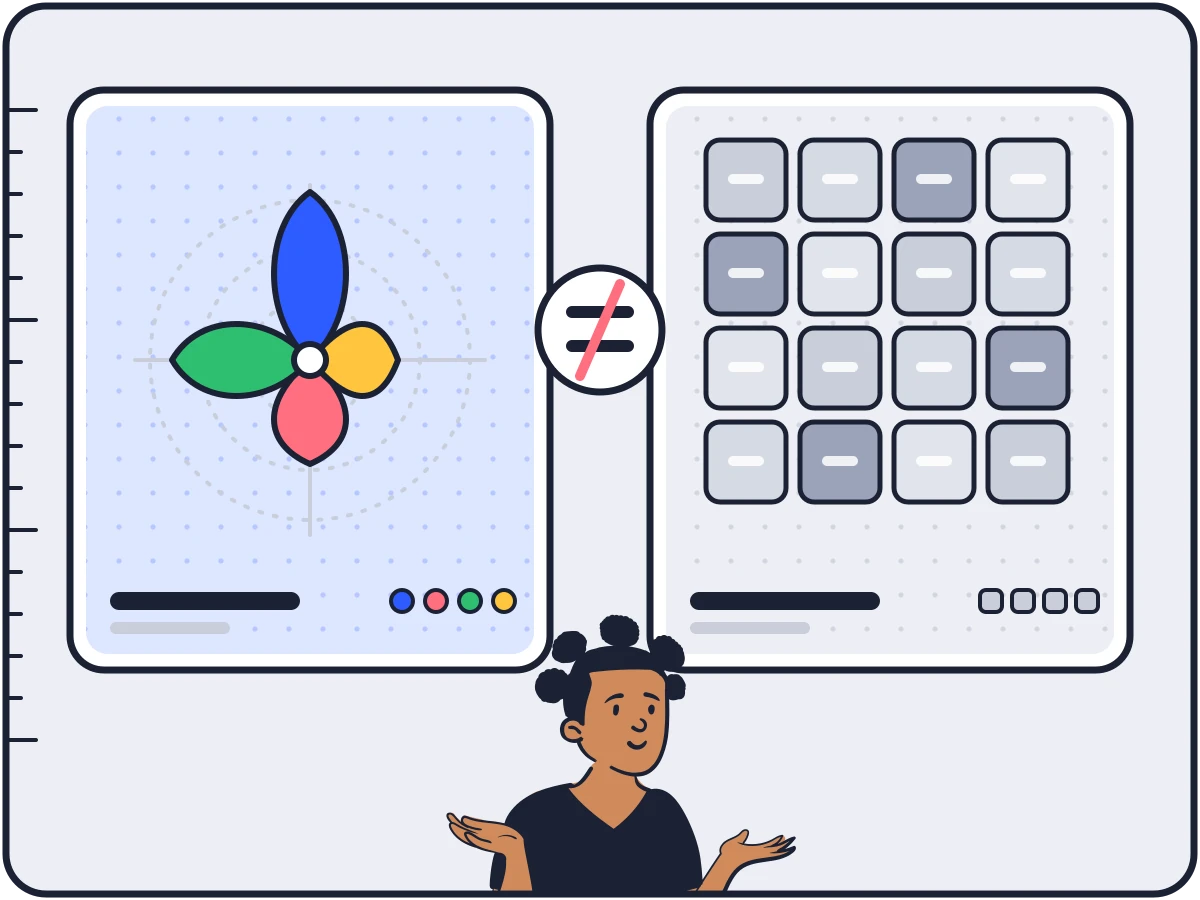
Jung's four functions: thinking, feeling, sensation, intuition
Four ways the mind meets a moment, and why Jung drew them as a compass
10 min read · Updated 27 November 2026

Open any page about Jung’s functions and you will find a wall of four-letter codes, stacks and “cognitive function” jargon. Most of it was added after Jung. What he wrote in Psychological Types in 1921 is shorter and stranger: four ways the mind deals with the world, drawn like the points of a compass.
Here is that idea in plain English, with his own words and paragraph numbers, a worked example you can picture, and a plain list of things he never said. If you would rather see which one you reach for first, the test takes about 6 minutes, has no sign-up and gives a free result.
What are Jung's four functions in one minute?
Jung used “function” for a way of working that stays the same whatever you are dealing with. He named four: sensation, thinking, feeling and intuition. He admitted he had no deeper reason for picking exactly these four (CW 6 §731).
His own one-line summary says that sensation tells you what is there, thinking what it means, feeling what it is worth, and intuition where it came from and where it is heading (CW 6 §958). The table below puts each one in everyday words.
| Function | The question it asks | What it looks like with friends or at work |
|---|---|---|
| Sensation | What is actually here? | You notice the draught in the room, the typo in the contract, how much money is left this month. |
| Thinking | What does this mean, and what follows? | You want the reason to hold up when someone pushes on it. You draw the plan and spot the gap in it. |
| Feeling | What is this worth? | You weigh what a choice costs the people and things you care about, even when you stay calm. |
| Intuition | Where could this go? | You see the opening before it is a door. You have a hunch about where the project is heading and cannot say how you know. |
Jung gave these four jobs, not four kinds of people. Everyone uses all of them. The interesting question is which one you reach for first, and which one you fumble.
Why does Jung set thinking against feeling?
The four sit in two pairs, and each pair pulls in opposite directions. Thinking and feeling are the two ways of making up your mind. Sensation and intuition are the two ways of taking things in.
Jung drew this as a cross: a rational axis crossing an irrational axis at right angles (CW 6 §983). Here “rational” does not mean sensible, and “irrational” does not mean silly. Rational means judging; irrational means perceiving without judging (CW 6 §§774, 785).
Feeling is a judgment, not a mood
This is the point most people get wrong. In everyday English, “feeling” means emotion. In Jung’s use it is a way of deciding, by value instead of by logic.
“Feeling, like thinking, is a rational function”
He separated it from affect, which is feeling with a strong jolt in the body, and from a vague hunch (CW 6 §§725, 951). So a person who leads with feeling is not necessarily emotional. They may be calm, and still be weighing, all the time, what each choice means for what matters.
He also noted that a thinking person is often wrong about feeling people, because their own feeling is the less developed side. Feeling values can be “logical, consistent and discriminating”, he wrote, just as thinking is (CW 6 §953).
Sensation and intuition both just take things in
Neither of these two judges. They register. Sensation registers the facts as they stand, before anyone has interpreted them. Intuition registers possibilities, in a way that arrives whole, without you being able to say how you got it (CW 6 §770).
Jung thought they get in each other’s way. Sensation, he said, rules out intuition at the same moment (CW 6 §983). If you are fully absorbed in the exact texture of the room, you are not also scanning for what it could become.
Neither is better. Jung called the irrational functions “in the highest degree empirical” (CW 6 §616), meaning they stay close to what actually happens. They simply do not decide anything.
What does the same situation look like through each function?
Priya’s friend Lena tells her over lunch that she is quitting her job next month with no plan. Four people could hear that sentence and respond to four different parts of it. Here is how each function would reach first.
- Sensation asks what exactly happened. Did something go wrong on Tuesday? How many months of rent does Lena have saved? When is her notice period over?
- Thinking asks what the logic is. What was the decision rule? If the job was bad, was quitting the right fix, or is there a cleaner option she has not weighed?
- Feeling asks what this means for Lena, and for the friendship. Is she happy about it or scared? What would it cost her to stay, and does she feel respected by the people around her?
- Intuition asks where this could lead. Is this the start of something, a different kind of work, a move abroad? What is the story that Lena is actually walking into?
None of the four replies is wrong, and a good friend probably makes all four across the conversation. But most people notice that one of them comes out of their mouth first, without effort, and another feels like a chore. That gap is what Jung was describing.
He added one more observation worth keeping. The function you use most is the one you can talk about, defend and rely on. The one you use least tends to turn up on its own, at odd moments, in an odd costume. We will come back to that below.
Which function do you reach for first?
Do not try to answer this by thinking about your personality. Think about the last three times a decision felt natural, and ask what you did first. Read the lines below and notice which ones you nod at fastest.
- When someone brings you a problem, you first check what actually happened and what the facts are.
- In an argument, what bothers you most is a point that does not add up, even if everyone is being nice.
- Before you decide anything, you quietly ask whether it is fair, and what it would cost the people involved.
- You often get a sense of where a situation is heading before you can explain why.
- You trust what you can see, touch, count or test, and get impatient with big talk that has no example.
- You like turning a mess into a clear explanation that someone else could use.
- You find it easy to say what a choice would be worth to someone, but hard to justify it in a spreadsheet.
- You are more energised by what could be than by what is, and you start things more easily than you finish them.
Jung warned that this kind of self-check is shaky. He wrote that judging your own type is “extraordinarily clouded” (CW 6 §3), and that people often adapt to what their job or family expects (CW 6 §§283, 560). So treat your answers as a prompt, and check them against real moments.
What are the lead function, the helper and the one you fumble?
Jung did not describe a flat list of four equal tools. In most people, he said, one function is far more developed than the others. It is the one you control most, and can lean on every day (CW 6 §667).
Next come one or two helper functions, which Jung called auxiliary. They are partly developed and never quite reach the lead’s level (CW 9i §431). He also set a rule about who can help whom: the helper has to come from the other pair. A thinker can be backed by sensation or intuition, but never by feeling, because that would mean two judging functions competing for the top job (CW 6 §668).
The fourth is the opposite of the lead. Jung called it the inferior function, “inferior” in a psychological but not a psychopathological sense (CW 6 §763). It is the least developed and the hardest to direct, and it tends to show up when you are worn out or stressed.
That is a topic of its own, so we gave it its own page: the inferior function. For now, one sentence will do. Jung thought the function you use least is not your weakness but your unlived side, and that at some point in life the need to bring it in tends to be felt (CW 6 §907).
Where do extraversion and introversion fit in?
Jung’s other big idea sits on top of the four functions. He called it the attitude, which means the direction your interest tends to flow. In extraversion it flows outward and the situation or other people set the course (CW 6 §710). In introversion it flows inward and your own reaction, impression or idea does (CW 6 §769).
This is not shyness and not sociability. A quiet person can steer by what the room needs, and a talkative one by an inner standard. Jung said everyone has both, and that no one is a pure type (CW 6 §6).
He also said that the attitude only shows through a function. You are not simply introverted in general; you are introverted or extraverted in how you think, or feel, or perceive (CW 6 §903). Two attitudes times four functions gives “at least eight” types in his description (CW 6 §913).
He did not stop there. He wrote that he did not regard the classification as the only possible one (CW 6 §914). He even dropped his own first idea that thinkers are always introverts and feelers always extraverts (CW 6 §§7, 836).
What did Jung not say about the four functions?
A lot of what circulates as “Jung’s functions” is a later layer. Here is a short correction table, with the source for what Jung wrote.
| The popular claim | What Jung actually wrote |
|---|---|
| Feeling means being emotional. | Feeling is a judgment of value, and a rational function (CW 6 §§725, 727). It is distinct from affect. |
| Thinkers are introverts and feelers are extraverts. | He abandoned that early equation (CW 6 §§7, 836). Any function can be extraverted or introverted. |
| Jung's types are four letters. | No codes appear in his book. The judging/perceiving pair behind a fourth letter was added later by Isabel Briggs Myers and Katharine Briggs (see the comparison with the MBTI). |
| The functions form a stack of four, with alternating directions. | We found no passage in CW 6 that gives the alternating rule or a named third function. It comes from later writers in the type tradition. |
| You are a type. | In his 1934 foreword he called using the types to label people “a childish parlour game”. Elsewhere he wrote that classification “does not explain the individual psyche” (CW 6 §895). |
One more caution. Jung’s own type descriptions contain gendered and dated lines, for example about which sex is supposed to favour which function (CW 6 §§591, 597, 613, 640). They are not findings, and we do not reuse them.
Questions people ask
Are Jung’s functions the same as MBTI functions?
They share names and roots, but the MBTI changed the structure: it uses four letter pairs and sixteen types. We compare the two in detail on the Jung versus MBTI page.
Can your lead function change?
Jung thought the basic leaning shows early and often looks innate (CW 6 §896). He also thought the neglected functions get their turn: “In time the need arises for the individual to develop what has been neglected” (CW 6 §898). So the habit is sticky, but not a life sentence.
Is there evidence that the four functions exist as measurable things?
Not in the sense of a settled scientific model. The functions come from a clinical theory of 1921. One early questionnaire built by Jungian analysts, the Gray-Wheelwright survey, was tested on 187 adults. Its thinking-feeling scale was much less reliable (about .38) than its other two scales (about .72 and .70) (Davis and Mattoon, 2006).
Another study found that the MBTI’s four scales behave more like continuous dimensions, related to the Big Five traits, than like clean either-or types (McCrae and Costa, 1989). That is why our test reports a pattern with bands, and says what is not clear. See how we score it.
Why a compass and not a box?
Because Jung chose the image himself. The four functions are “somewhat like the four points of the compass”, he wrote, “just as arbitrary and just as indispensable” (CW 6 §§958-959). A compass tells you where you are standing and which direction is under-used. It does not tell you who you are.
Sources
- C. G. Jung, Psychological Types, Collected Works vol. 6 (Princeton/Bollingen, Hull translation): Foreword to the Argentine edition (1934); §§3, 6-7, 283, 560, 616, 667-670, 710, 725-731, 763, 769-770, 774, 835-836, 895-914, 951-959, 983
- C. G. Jung, The Archetypes and the Collective Unconscious, Collected Works vol. 9 part 1, §431 (the superior, auxiliary and inferior functions)
- Davis, M. F., and Mattoon, M. A. (2006). Reliability and validity of the Gray-Wheelwright Jungian Type Survey. European Journal of Psychological Assessment, 22(4), 233-239.
- McCrae, R. R., and Costa, P. T. (1989). Reinterpreting the Myers-Briggs Type Indicator from the perspective of the five-factor model of personality. Journal of Personality, 57(1), 17-40.
- The Jungian Test, how the test works and where Jung stops