Jung on Projection: Seeing a Part of Yourself in Someone Else
What he wrote about it, how it differs from the Freudian version, and a plain check for your own strong reactions
9 min read · Updated 28 November 2026
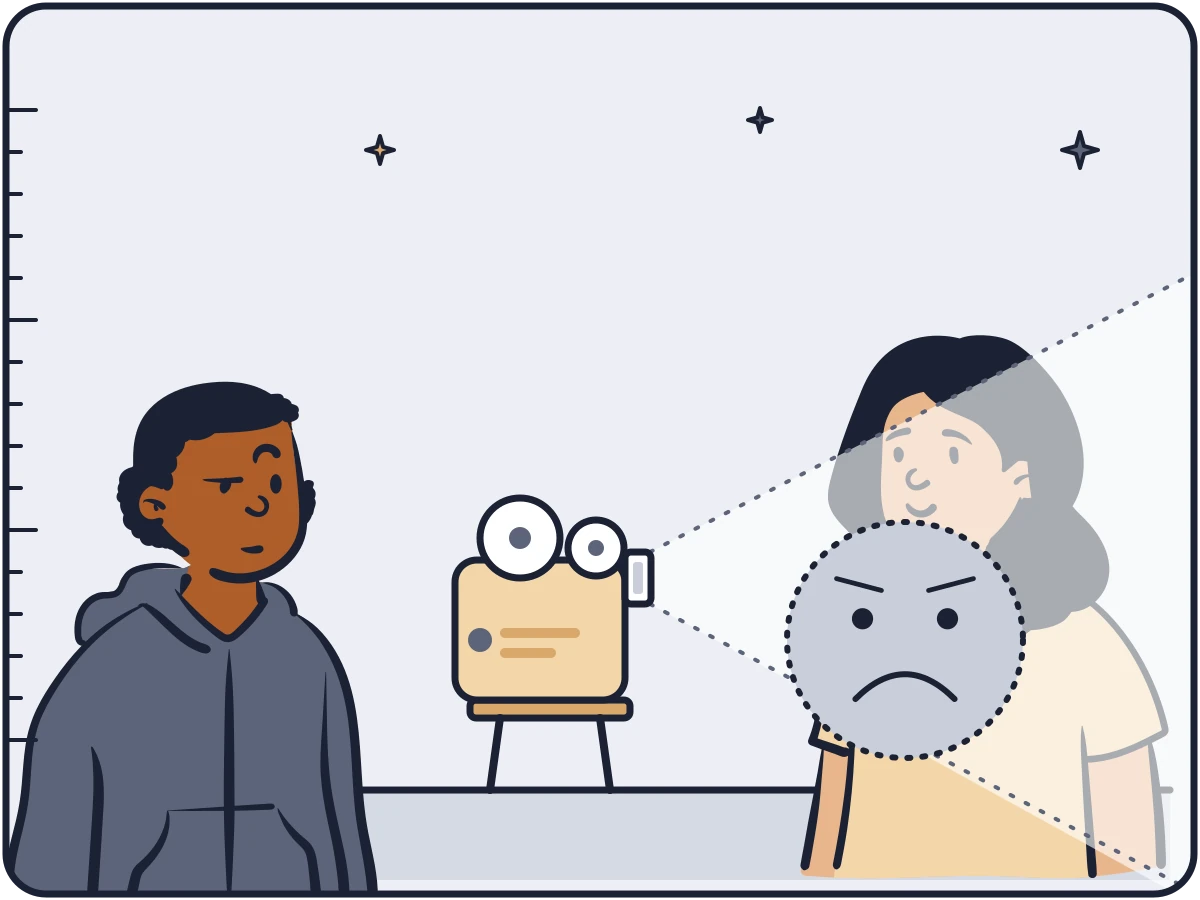
Leo, 25, cannot stand his new colleague Jess. She is “so fake nice”, he tells his flatmate, and he spends a lunch break working out what she is after. Two weeks later he notices that he has been smiling too hard at everyone since his first day.
Carl Jung had a word for what Leo ran into: projection, which means finding a part of yourself in another person without knowing it. This page covers what Jung wrote about it, with paragraph numbers, how it differs from the Freudian version, and how to check a strong reaction of your own. If you want a mirror first, the test takes about 6 minutes, with no sign-up.
What is projection in Jung's psychology?
Jung’s textbook definition, from Psychological Types in 1921, is plain.
“the expulsion of a subjective content into an object”
He separated an active kind, which he tied to empathy, from a passive kind, and the passive kind is the one this page is about. Of that kind he wrote that these projections are not intentional.
“they are not intentional and are purely automatic occurrences”
So projection is not lying and it is not blaming someone on purpose. You do not decide to do it, and from the inside it does not feel like anything. It feels like seeing the other person clearly.
Jung thought it was everywhere. In his essay on dream psychology he wrote that it is the natural thing for unconscious contents to be projected, and that all human relationships swarm with these projections (CW 8 §507). That is the first thing most pop pages leave out: he meant the usual state of affairs, not a rare glitch.
Does the other person have to be innocent?
No, and this is the part of Jung that makes projection usable. He wrote that the other person is not wholly without blame, because a projection needs something to hang on.
“even the worst projection is at least hung on a hook”
He went on to say the hook can be a very small one, but it is one the other person offers. So Jess may well be a little performative. Her hook is real, and Leo’s reaction is still bigger than the hook.
That gives you two separate questions, and Jung’s remark about quarrels is a good way to hold them. He wrote that with a grain of salt we always see our own unavowed mistakes in our opponent (CW 8 §507). The “grain of salt” matters: sometimes the opponent is simply wrong.
In the same essay he described what the mistake costs. When something irritates you out of your wits, he said, you give the other person the power to put you in that state. Meanwhile you rage against a part of yourself that sits in them (CW 8 §516).
How can you tell you are projecting?
Jung gives no checklist, but his observations turn into questions. Two are on the shadow page: a reaction bigger than the facts, and a sense that the cause lies beyond doubt in the other person (CW 9ii §16). Here are four more, each tied to a passage. They are our reading of Jung, so use them as prompts rather than tests.
- Would a neutral observer see it? Jung wrote that however obvious it is to a neutral observer, there is little hope the person will see it himself (CW 9ii §16). Ask someone who knows both of you.
- Is your picture bigger than the person? In a passage on parents, Jung pointed out that your idea of a person is the picture you received plus your own changes to it. The real person is only in part responsible for it (CW 9ii §37). Write down what you actually saw them do, then what you added.
- Does the same story keep repeating? Jung noted that everyone builds a series of imaginary relationships based largely on projection (CW 8 §507). If three different bosses are all “controlling”, the common factor deserves a look.
- Do you need them to stay that way? He wrote that we want better relations, but only on the condition that others become “willing carriers of our projections” (CW 8 §517). Notice whether you would be disappointed if Jess turned out to be sincere.
None of these proves anything. The aim is to compare what you feel with what you can point to, which is what Jung asked for when he said we must compare our assumptions with the objective facts (CW 10 §577).
Why does projection show up most at work and in love?
Jung noticed a rough pattern about where projections land. In ordinary people, he wrote, the favourable ones go to someone close at hand and the unfavourable ones to someone at a distance, and “anything strange is hostile and evil” (CW 8 §517). A new colleague is both a stranger and a screen.
At work: the colleague or boss you cannot stand
Jung traced the first projections to childhood. He wrote that a child meets what stands in the way of its instincts in the form of its parents, and that everything working from the unconscious appears projected on others (CW 8 §99). Our reading is that a boss with authority over you is an obvious candidate for the same old shape, but only a candidate. Check the facts.
In love: the person who seems perfect
Projection is not only for people you dislike. Jung’s 1921 definition includes the positive values that you cannot reach yourself, for example because you think too little of yourself (CW 6 §783). That is one way to read the feeling that someone is exactly what you were missing.
He also described what projection does to a relationship. Instead of a real relation to the other person there is now only an illusory one (CW 9ii §17). He wrote about falling for someone in terms of his anima and animus theory, with dated, gendered wording that we leave aside. The part that carries over is that an inner picture can land on a real person, and the longer it stays there, the less the real person is met.
Take Leo and Ari, three dates in. Ari seems calm, funny and never in a hurry, all the things Leo is not. By the sixth date Ari is late twice and Leo is crushed, which is a bigger reaction than being late deserves. The charge points back to the picture Leo built, not only to Ari.
The love side has its own page, Jung on love.
Is Jung's projection the same as Freud's?
Not quite. In classical psychoanalytic theory, projection is a defence mechanism: unacceptable impulses, traits or responsibilities are assigned to someone else, which lets you avoid seeing your own faults (APA Dictionary of Psychology). Jung kept the mechanism and widened it.
The table sets the two side by side. The Freudian column comes from a reference work and not from Freud’s own pages, so treat it as a short summary.
| Freudian defence mechanism | Jung's projection | |
|---|---|---|
| What is projected | Unacceptable impulses, traits and responsibilities | Painful contents, and also valued qualities that feel out of reach (CW 6 §783) |
| Purpose | A defence: it helps you avoid seeing your own faults | No purpose: an automatic event (CW 6 §784) |
| How common | One defence among several that people use | Everywhere, in all ordinary relationships (CW 8 §507) |
| What to do about it | Not covered in the definition we checked | Gradually take it back, which he said demands self-criticism (CW 10 §577) |
That is why Jung’s version is less accusing. You are not hiding from something on purpose. You are seeing a part of yourself where you do not expect to find it.
Can you stop projecting?
Jung’s honest answer is not completely. He wrote that unless we have an unusual degree of self-awareness we will always be caught in our projections, because the mind in its natural state expects them (CW 8 §507). He also noted that favourable projections work as convenient bridges to other people, so there is no rush to cut them all.
What he recommended instead is the withdrawal of projections. He wrote that nothing promotes understanding between people more than the mutual withdrawal of projections, and that it demands self-criticism (CW 10 §577). You cannot tell someone else to do it, he added, since they do not recognise their own projections any more than you do.
He also warned that it costs something. Once you have noticed your projections, the easy channel for love and hate is gone, and you have to put down to your own account what you blamed on others (CW 8 §517). Our reading is that this is why it is worth doing slowly and with friends who tell you the truth.
Here is a small, ordinary way to try it this week. Pick one person who annoys or dazzles you. Write two lines about what they actually did, then one line about what you assumed. Then ask whether a small version of the quality could be yours, and who could tell you.
It is fine if the honest answer is “no, they are just like that”. If a strong reaction is heavy or keeps coming back, a professional is the right person to talk to. This site is a reflection tool and not therapy.
What do people get wrong about Jung's projection?
| The popular claim | What Jung wrote |
|---|---|
| "Everything that irritates you is your shadow" | He said a projection needs a hook offered by the other person (CW 8 §99), and a strong reaction is a hint to check, not a verdict (CW 9ii §16). |
| "Projection means blaming others on purpose" | He called passive projections unintentional and purely automatic (CW 6 §784). |
| "Projection is always negative" | It can carry values you feel are out of reach (CW 6 §783), and favourable projections serve as bridges to other people (CW 8 §517). |
| "Just stop projecting" | He wrote that there is little hope the person will see it himself (CW 9ii §16) and that withdrawal demands self-criticism (CW 10 §577). |
| "It is a Freudian idea" | Classical psychoanalysis treats it as a defence mechanism (APA). Jung’s wider, automatic version is a different account, set out in the table above. |
Our test does not detect projection, because it only reflects how you describe yourself in a few scenes. It gives you a function profile that you can check against real moments (see the method), and the projection check above is the part you can do yourself.
Questions people ask
What is an example of projection?
Leo decides that Jess is fake before he has seen her do anything fake, because he is anxious about how he comes across in the new job. A neutral friend who watched her at the next meeting would help him separate her hook from his charge.
Is projection the same as the shadow?
No. The shadow is the disowned part of you, and projection is one way you run into it. Not all projection carries shadow, since positive values can be projected as well. For the shadow itself, see what Jung wrote about it.
How do the persona, shadow and ego fit together?
They are three parts of one personality, and projection links the last two. The persona, shadow and ego table puts them side by side.
Is projection always unconscious?
While it is happening, yes. Jung’s definition goes a step further: it is called a projection in the proper sense only once the old identity between you and the other person has become noticeable (CW 6 §783).
Sources
- C. G. Jung, Psychological Types (Collected Works vol. 6, Hull translation), Definitions, “Projection”, §§783-784
- C. G. Jung, The Structure and Dynamics of the Psyche (CW 8), “On Psychic Energy” §99; “General Aspects of Dream Psychology” §§507, 516-517
- C. G. Jung, Aion (CW 9 part 2), chapter 2 “The Shadow”, §§16-17, and chapter 3 “The Syzygy: Anima and Animus”, §37
- C. G. Jung, Civilization in Transition (CW 10), “The Undiscovered Self”, §§576-577
- APA Dictionary of Psychology, entry “projection” (American Psychological Association), for the Freudian definition