What Is the Self in Jung's Psychology? The Ego, the Self and What You Cannot Know
The whole of you, most of which you do not know, and why no test can hand it to you
8 min read · Updated 28 November 2026
Amara, 27, has ten tabs open on a Sunday evening. “Find your true self.” “What is my Jung archetype?” “Ego vs self.” She wants one answer to all three, preferably a label.
Jung’s self is not that answer. It is also not the ego, and it is not a type you can be assigned. This page sets out what he meant by it, with paragraph numbers, shows ego and self side by side, and says what to do with an idea about a part of you that is unknown by definition. If you want a different kind of mirror, the test takes about 6 minutes, with no sign-up.
What is the self in Jung's psychology?
Jung defined it in 1921 and restated it in Aion in 1951 as a concept that includes the ego in a larger one. His wording there is the total personality that is present but cannot be fully known.
“the total personality which, though present, cannot be fully known”
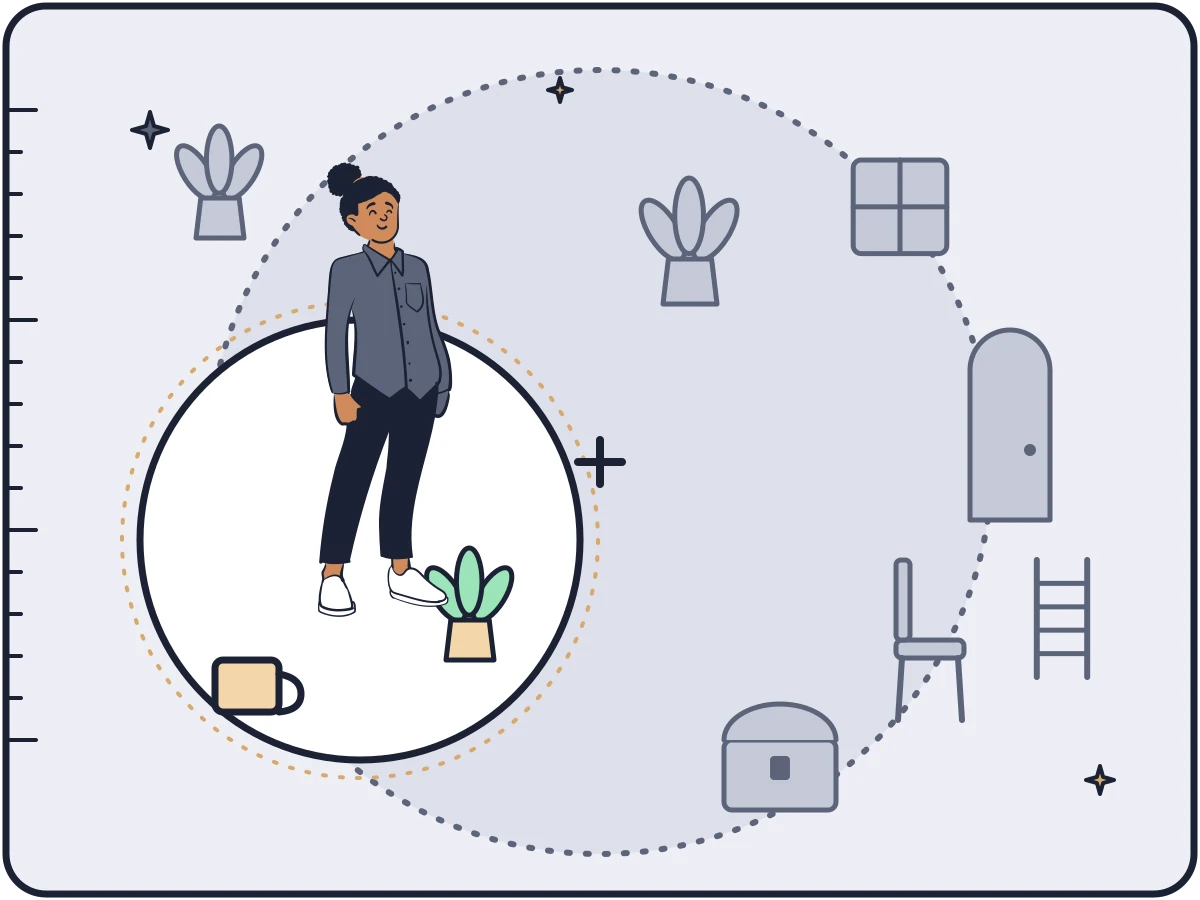
He gave a second picture in Psychology and Alchemy. The self is the centre, but it is also the whole circle around that centre, which takes in both the conscious and the unconscious. The ego is the centre of consciousness only (CW 12 §44).
His glossary of 1921 says it in more technical words. The self “expresses the unity of the personality as a whole” (CW 6 §789). He added that, since part of the personality is unconscious, the self is partly a postulate. It includes the experienceable and what is not yet experienced.
A small note on spelling. The Hull translation we checked prints “self” in lower case. Later books often write “Self” with a capital, but that is later usage.
What is the difference between the ego and the self?
Think of the ego as the part of you that is looking, and the self as everything that is there to be looked at, including the one looking. Jung put the relationship as a part to a whole: the ego is subordinate to the self and is related to it like a part to the whole (CW 9ii §9).
| Ego | Self | |
|---|---|---|
| What it is | The centre of your field of consciousness (CW 6 §706) | The whole psyche, and its centre (CW 12 §44) |
| How much of you | A part: “part of the personality but not the whole of it” (CW 9ii §11) | The whole, which cannot be fully known (CW 9ii §9) |
| Can you picture it? | Yes, you look out from it | Not clearly: beyond our powers of imagination (CW 7 §274) |
| Free will | Free choice inside consciousness (CW 9ii §9) | Acts on the ego like an objective event that free will can do very little to alter (CW 9ii §9) |
| What you know of it | What you are aware of | “The ego is the only content of the self that we do know” (CW 7 §405) |
Two more lines in the Two Essays are worth keeping. Jung said the self has as much to do with the ego as the sun has with the earth, and that the two are not interchangeable (CW 7 §400).
“The ego is the only content of the self that we do know”
Persona and shadow are, in this picture, parts of you that the ego can meet. The persona, shadow and ego comparison puts all four in one table.
Is the self really an archetype?
Jung did call it one. In Aion he writes of “the archetype of the self” (CW 9ii §125). An archetype, for him, is an inherited pattern of the psyche that shows itself in images and experiences, and it comes with a caution.
The caution is Jung’s own. He wrote that the idea of a collective layer beneath the personal one is “no more than a hypothesis” (CW 9ii §12). About the self specifically he wrote that, as an idea, it is only a working hypothesis (CW 6 §791), and that intellectually it is a psychological concept, a construct (CW 7 §399).
“does not allow of scientific proof”
That phrase refers to the idea of the self itself. Jung called it a postulate that, although it can be justified psychologically, cannot be proved scientifically, and he compared its value to a hypothesis such as the structure of the atom. So when a page says “your self archetype is...”, it is making a claim Jung did not make.
What about the usual “examples”? In his glossary Jung lists the figures in which the self appears in dreams, myths and fairytales: a supraordinate personality, such as a king, hero or prophet (CW 6 §790). He also noted that, seen empirically, the self appears as a play of light and shadow, which is not a flattering picture of a “best self” (CW 6 §790). Jung also wrote about the self in religious terms, and this page leaves that side aside.
Is the self your "true self"?
Self-help pages often say that the self is the real you under the mask, to be found and expressed. That is not what Jung wrote, and the table shows five common readings and what he did write.
| The popular reading | What Jung wrote |
|---|---|
| "The self is the real you hidden under your mask" | Jung said we can see ourselves as a persona without much trouble, but cannot picture what we are as a self (CW 7 §274). |
| "Find it and you will know who you are" | He saw little hope of reaching even approximate consciousness of the self, because an unknowable amount of the unconscious always belongs to it (CW 7 §274). |
| "It is your best, most positive side" | He described the self as a play of light and shadow (CW 6 §790). It includes the shadow. |
| "The self means self-esteem or self-love" | It is not interchangeable with the ego (CW 7 §400), and it is not a feeling about yourself. |
| "It is a personality type" | Not in Jung. His types are attitudes and functions in Psychological Types, a different book and a different system (see below). |
The honest version of “know yourself” in Jung’s terms is therefore more modest. He wrote that the most decisive qualities in a person are often unconscious and can be perceived only by others (CW 9ii §7). That is a very practical sentence, and we come back to it at the end.
What is my Jung archetype, and can a test tell me?
No. The self is not something Jung sorted people into, and no test can hand it to you. Everyone has a self in his sense, and each person’s is unique and mostly unknown to them.
What Jung did sort people into are attitudes and functions: whether energy turns outward or inward, and which of thinking, feeling, sensation and intuition leads (CW 6). That is a different system from archetypes. Jung’s four functions explains it, and Jung’s typology vs the MBTI says what later systems added.
On archetypes themselves, Jung was blunt that lists do not help. He wrote that it is no use at all to learn a list of archetypes by heart. Archetypes, he said, are complexes of experience that come upon us like fate (CW 9i §62). The popular lists of twelve come from later writers, and the archetypes article covers where.
The test on this site works at the level of the ego. It reads how you describe yourself in short scenes and gives a ranking of the four functions with a nickname. It does not give an archetype, and it cannot reach the self, since the ego knows only itself among the contents of the self (CW 7 §405). The method page says what it does and does not do.
How does the self connect to individuation?
Jung used the self as the centre that individuation moves towards. When you take in more of the unconscious, he said, the centre of the total personality no longer coincides with the ego but sits at a point midway between the conscious and the unconscious (CW 7 §365).
That sounds abstract, and it is one of the later and rarer parts of his scheme. A present-day Jungian analyst, Martin Schmidt, writing for the International Association for Analytical Psychology, describes the first half of life as building a strong ego and the second as asking the ego to step back. That fits Jung’s own view of the stages of life.
The full process has its own page, Jung’s individuation, including why Jung did not offer it as self-improvement.
What can you do with an idea about the part you cannot know?
Since the self is unknowable by definition, the practical use is small and honest. It is a reminder that your description of yourself is the ego’s description.
- Ask three people for three words each. Pick people who know you in different settings. Jung’s line is that others can perceive decisive qualities (CW 9ii §7).
- Put their words next to yours. The overlap is what the ego already knows. The gap is a hint, not a verdict.
- Wait before you decide what a gap means. One surprising word from one person is not a finding. Three different people saying the same thing is worth thinking about.
If this brings up something heavy or that keeps coming back, a professional is the right person to talk to. This site is a reflection tool, not therapy.
Questions people ask
Is the self the same as the ego?
No. The ego is the centre of consciousness. The self is the whole psyche and its centre, and the ego is related to it like a part to the whole (CW 9ii §9).
Is there a self archetype test?
Not one that Jung or this site offers. He called the self a construct and a hypothesis (CW 7 §399, CW 6 §791), which is not something a questionnaire can measure.
Is the self a religious idea?
Jung wrote about it in religious language too. We leave that part aside here, and the test does not touch it. As a psychological concept, it is a name for the whole personality.
Does everyone have a self?
In Jung’s sense, yes. It is the total personality, so it is not something you earn or lack.
Sources
- C. G. Jung, Aion (Collected Works vol. 9 part 2, Hull translation), chapter 1 “The Ego”, §§7, 9, 11-12, and chapter 5 “Christ, a Symbol of the Self”, §125 (only the phrase “the archetype of the self”)
- C. G. Jung, Psychological Types (CW 6), Definitions, “Ego” §706 and “Self” §§789-791
- C. G. Jung, Two Essays on Analytical Psychology (CW 7), “The Relations between the Ego and the Unconscious”, §§274, 365, 399-405
- C. G. Jung, Psychology and Alchemy (CW 12), §44
- C. G. Jung, The Archetypes and the Collective Unconscious (CW 9 part 1), §62
- Martin Schmidt, “The self”, short articles on analytical psychology, International Association for Analytical Psychology