Jung's stages of life: what "morning" and "afternoon" really mean
An honest walk through one essay, with the dated parts marked
9 min read · Updated 27 November 2026
In “The Stages of Life”, Jung says the first half of life is for building an outer life, and the second half asks different questions, about meaning and what you left unlived. He put the turn at around thirty-five to forty. His evidence was clinical impressions, and some of the essay has not aged well.
This page walks through what he actually wrote, paragraph by paragraph, and marks what holds up and what does not. If you are in your twenties, the practical side is on a separate page. To see which task your own life seems to hold, the test is free, takes about six minutes and needs no sign-up.
What does Jung mean by the morning and afternoon of life?
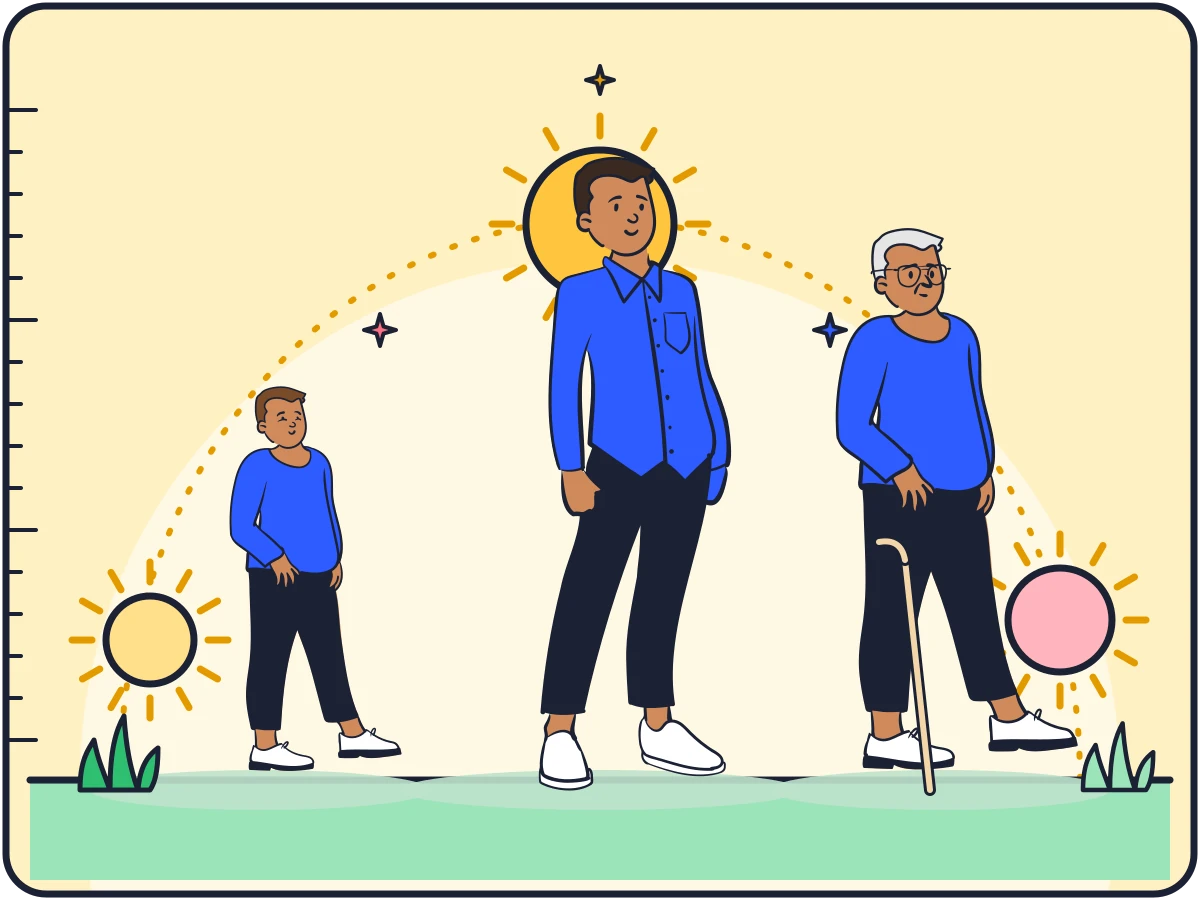
Jung uses the path of the sun as a picture. The sun rises, climbs, and reaches noon, and then it starts down. His claim is that a life has the same shape, and that the second half cannot be run by the rules of the first.
“At the stroke of noon the descent begins.”
He says what changes at noon is not only energy but values: the descent means a reversal of the ideals cherished in the morning (CW 8 §778). In another line he writes that we cannot live the afternoon “according to the programme of life’s morning” (CW 8 §784).
Where did the idea come from? Jung’s clinical work. In a later volume he says he had the most trouble with patients over forty, and that he could “almost speak of a psychology of life’s morning and a psychology of its afternoon” (CW 16 §75). The essay was already available in English by 1933, in Modern Man in Search of a Soul.
He also argued that the afternoon deserves respect. In that 1933 book he writes that it “must also have a significance of its own” (as quoted in a 2015 review by the psychologist Margie Lachman). He did not want older age treated as a sad appendix to youth.
What does the essay say, stage by stage?
The essay runs from CW 8 §749 to §795. It is not a table of neat stages like the ones you may know from other psychologists. It is a long argument with a few clear turning points, and we follow them in order.
Childhood
Childhood, for Jung, has no problems of its own yet. The child depends on its parents, so “nothing depends upon the subject”, as he puts it, and the real trouble starts at puberty, when a separate psychic life begins (CW 8 §756).
Youth and young adulthood
Youth is the period of the morning. Its typical problem is “a more or less patent clinging to the childhood level of consciousness” (CW 8 §764): part of you wants to stay looked after while the world asks you to take part in it.
Young adulthood, in his account, is rightly one-sided. “We limit ourselves to the attainable” (CW 8 §770), and this means giving up other possibilities. The goals you reach come at the cost of a diminution of personality, with many unlived parts of life stored away (CW 8 §772).
He adds a caution that people forget. The serious problems of life are never fully solved, and if one ever seems to be, he takes it as a sign that something has been lost (CW 8 §771).
The turn
Around thirty-five to forty, Jung thought, “an important change” is in preparation (CW 8 §773). He writes that depression becomes more frequent in men around forty, and that women’s difficulties start somewhat earlier. He gives no source for these “statistics”, which matters when we reach the section on what is dated.
He describes two possible outcomes. One is a slow change of character. The other is a hardening of convictions into intolerance and fanaticism by about fifty (CW 8 §773). He says the turn can come late, for example when a person’s parents live long (CW 8 §774).
He also describes adult neurosis as an attempt to carry “the psychology of the youthful phase over the threshold” (CW 8 §776). In plain words: some people try to live their forties by the rules they learned at twenty.
The afternoon
In the second half, Jung says, an ageing person should give “serious attention to himself” (CW 8 §785), because a life that has stopped expanding needs a different kind of attention. He lists the ways it goes wrong: “hypochondriacs, niggards, pedants, applauders of the past or else eternal adolescents” (CW 8 §785).
He also says that whoever carries the law of the morning into the afternoon pays for it (CW 8 §787). He even calls money-making, social achievement and family “plain nature, not culture” (CW 8 §787), which is his way of saying that these are necessary but are not the whole of a human life. Later pages deal with old age, which this page leaves out.
What is the first-half job, in plain words?
Build a footing. Learn to work, follow through, hold a place in the world and stay in it. Jung says plainly that for a younger person the job is to clear away what hinders expansion and ascent (CW 7 §114), and that the young must shape the conscious ego and educate the will (CW 16 §§109-110).
None of that is a mistake or a phase to be ashamed of. The narrowing, the commitments and the roles are how a life gets started. Jung even observes that society pays for achievement, not for personality (CW 8 §768), which explains why most people spend the morning doing what pays.
The risk is not the morning. The risk is thinking it is the whole day. A person who has built a good role, and has no sense of anything beyond it, may feel fine until the role stops working. If you want the longer treatment of how the first-half job feels in your twenties, and the practical things to watch for, see feeling lost in your 20s.
What does the second half ask of you?
Jung’s answer is that it asks you to turn attention inward. The questions change from “how do I get ahead?” to “what was all this for, and what did I leave out?”. The goals of the morning, he says, look smaller in the evening: what was great in the morning will be little by night (CW 8 §784).
In his later book on psychotherapy he sets the two tasks side by side. The young person must shape the ego and educate the will. The older person “needs to experience his own inner being” (CW 16 §§109-110). That is the clearest summary of the two halves in his own words, and it is the one we rely on.
A short table helps. It is our own arrangement of his points, with the paragraph for each row.
| Morning programme | Afternoon questions | |
|---|---|---|
| The main job | Shape the ego, adapt, commit (CW 16 §§109-110) | Turn attention to yourself (CW 8 §785) |
| How you spend yourself | Narrow down to the attainable (CW 8 §770) | Ask what the narrowing left out (CW 8 §772) |
| What success looks like | Achievement, position, family (CW 8 §§768, 787) | Values reversed or relativised (CW 8 §778) |
| The typical way to fail | Clinging to childhood (CW 8 §764) | Applauding the past, or staying an eternal adolescent (CW 8 §785) |
| Jung's advice to others | Clear obstacles to ascent (CW 7 §114) | Support the descent (CW 7 §114) |
Which parts of the essay hold up, and which do not?
An essay that is almost a century old, built on a clinician’s impressions, deserves a straight reading. Some of it is a useful way to think about change. Some is not supported by anything we can check today.
| Claim in the essay | Status |
|---|---|
| Depression rises around forty (CW 8 §773) | No source is given for the “statistics”. Do not repeat it as a fact. |
| The turn comes at about 35 to 40 (CW 8 §773) | A clinical impression. Jung himself says it can be delayed (CW 8 §774) and that many people never face it (CW 8 §784). |
| Many patients are in the second half (CW 16 §§83-84) | He says about two thirds of his patients were past that point. That was a clinical sample, not a cross-section of the population. |
| Men and women swap psychic traits at midlife (CW 8 §§780-783) | Dated and not defensible: it rests on gender stereotypes and physical claims. We do not quote or use these paragraphs. |
| The first half needs a strong ego, and the second a different task (CW 16 §§109-110) | A reasonable, modest idea. It does not depend on a particular age. |
What about the “midlife crisis” that people attach to this essay? Jung’s claim is about a change of task and values, which is not the same as distress or collapse. The empirical side is also weaker than the meme suggests. A 2015 review by Margie Lachman reports that between 10 and 20 percent of adults say they have had a midlife crisis (citing Elaine Wethington’s 2000 study), and calls the evidence for a regular midlife crisis “weak at best”.
So the honest summary is this. Jung’s picture of two different life tasks is a thoughtful hypothesis. A fixed age for the turn, and any claim that everyone must go through a crisis, are not supported. Where Jung stops being reliable more generally is set out on our page about his limits.
So which half are you in?
Not a question your birthday can answer. Jung says delays happen (CW 8 §774) and that many people never make the turn (CW 8 §784). A person of twenty-five can be asking afternoon questions, and a person of fifty can still be in the middle of the morning job.
A better test is the task your life seems to hold now. Read these lines and notice which ones sound like you this month.
- I am working to prove I can do this, to myself or to someone else.
- I am still working out how to stand on my own: money, home, a skill someone will pay for.
- I have what I was aiming for, and it feels smaller than I expected.
- I keep asking what all this effort is for.
- I am doing things the way I did at twenty, even though they no longer fit.
- I recognise both lists, depending on the day.
The first two lean toward the morning task. The third to fifth lean toward the afternoon questions. The last is normal, and common: Jung’s own account says the two tasks do not switch cleanly on one birthday.
None of this is a score or a stage. It is a prompt to check against your real weeks, which is also how our method page describes the way the test uses it.
Questions people ask
Did Jung say “life begins at forty”?
We found no source for it in his writings. What he wrote is that the afternoon of life has a meaning of its own (CW 8 §§784-787), which is a different and more careful claim.
Is the midlife crisis real?
Some people have one, and some people have a hard time in their forties for ordinary reasons such as a job loss, a divorce or an illness. Research suggests it is not a regular, universal event (Lachman 2015, citing Wethington 2000). Jung’s afternoon, in any case, is not the same thing: it is a change of task, not a breakdown.
Are there four stages of life, like in Erikson?
Not in this essay. It has no numbered ladder of stages. The “four stages” you may see attached to Jung usually refer to the four stages of therapy in a different book (confession, elucidation, education, transformation), which he says do not replace one another and are not life stages (CW 16 §§122, 159).
Where do my twenties fit?
In Jung’s terms, the morning: the time for building a footing and accepting the narrowing that comes with it. That is not the whole story, because feeling lost is common there too. Our page on feeling lost in your twenties takes that up directly.
Is this the same as individuation?
No. The two ideas are related, but individuation is a much larger and riskier process, which Jung did not offer as a plan for everyone. See what individuation actually means, and Jung’s persona for the role you build in the morning.
Sources
- C. G. Jung, “The Stages of Life”, in The Structure and Dynamics of the Psyche, Collected Works vol. 8, §§749-795 (Hull translation)
- C. G. Jung, The Practice of Psychotherapy, Collected Works vol. 16, §§75, 83-84, 109-110, 122, 159 (Hull translation)
- C. G. Jung, Two Essays on Analytical Psychology, Collected Works vol. 7, §114 (Hull translation)
- C. G. Jung (1933). Modern Man in Search of a Soul. New York: Harcourt, Brace (the English publication of “The Stages of Life”; p. 109 as quoted in Lachman 2015)
- Lachman, M. E. (2015). Mind the gap in the middle: A call to study midlife. Research in Human Development; summarises Wethington (2000), Expecting stress: Americans and the “midlife crisis”, Motivation and Emotion, 24, 85-103.