What Is Ego Inflation? Jung's Idea, Including the Version That Feels Like Self-Hatred
A swelling of the self-image, up or down, and what Jung said keeps the ego in proportion
7 min read · Updated 28 November 2026
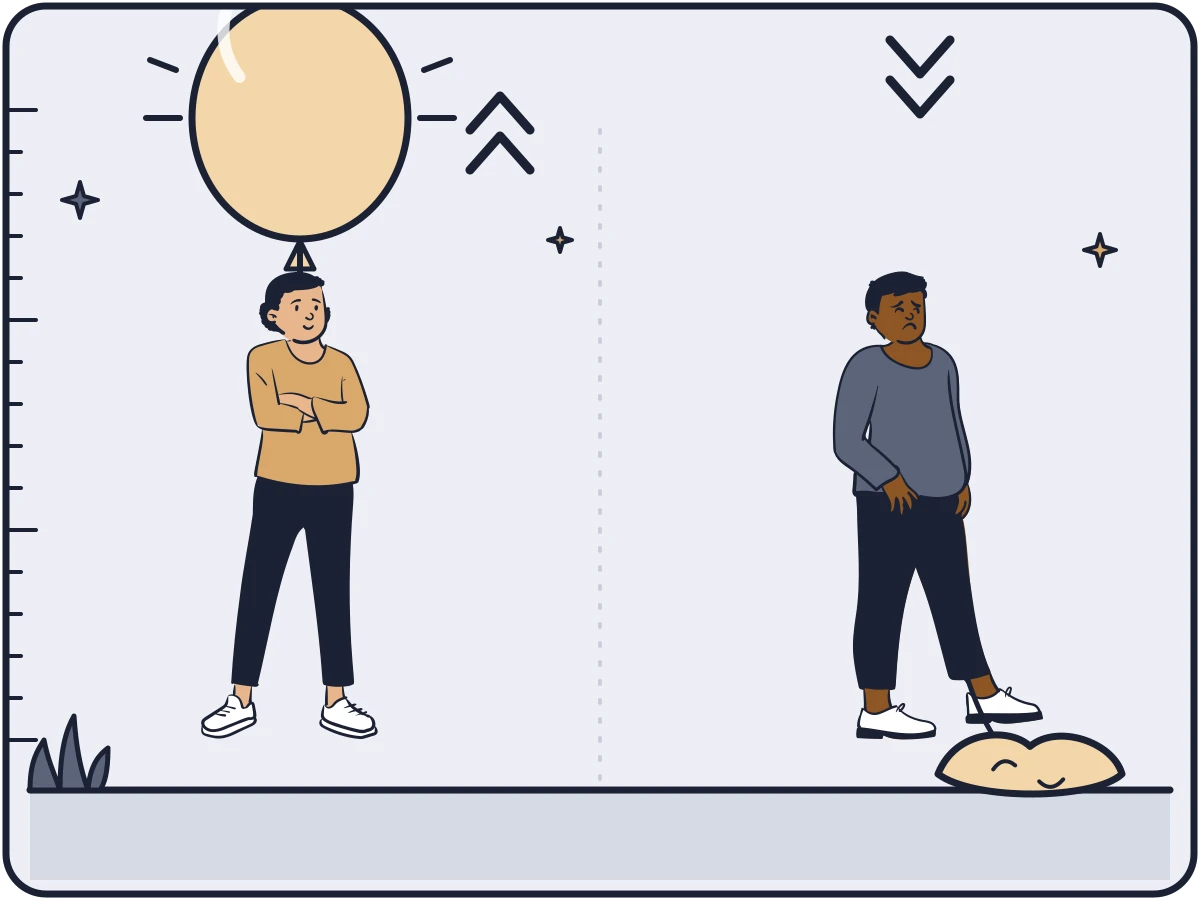
Jonas, 24, reads two books on Jung over a weekend. By Monday he is telling the group chat who is projecting and why his team lead is a textbook case. By Friday a friend has said, kindly, that he is a lot, and Jonas decides he is the worst person he knows.
Jung had one word for both halves of that week: inflation. This page covers what he meant, with paragraph numbers, why the “big ego” meaning is not his, and what he said helps. If you would like a mirror first, the test takes about 6 minutes, with no sign-up.
What is ego inflation in Jung's psychology?
Jung gave his definition while describing what happens to people who have just learned something big about themselves. He called it psychic inflation and said it is a state of being puffed up.
“an extension of the personality beyond individual limits”
He added a picture of how it works. In such a state, he wrote, a person fills a space that normally he cannot fill. What lies outside ourselves belongs to someone else, or to everyone, or to no one, and the inflated person has taken it as their own (CW 7 §227).
If “ego” is a loose word for you, the persona, shadow and ego page sets it out in one table. In short, it is the part of you that says “I”, and it is not the whole of you (CW 9ii §11).
Is ego inflation the same as having a big ego?
No. In everyday speech, a big ego means a person who is full of themselves. Jung’s inflation is wider, and it is mostly not something you can feel from the inside.
He said so directly in Aion. The condition, he wrote, should not be taken as conscious self-aggrandizement, and that is far from the rule.
“should not be interpreted as one of conscious self-aggrandizement”
He suggested we usually know it only indirectly, from the symptoms, including how the people around us react. One clear sign, he said, is a growing disinclination to take any notice of those reactions.
“our growing disinclination to take note of the reactions of the environment”
That is a useful test because it is behavioural. Ask whether you have recently stopped hearing what people say to you. In a later essay he put the strongest version of the same idea: an inflated consciousness is “hypnotized by itself and therefore cannot be argued with” (CW 12 §563).
What are the two forms, swelling up and shrinking down?
Jung described both in one passage. After people take in a lot of new self-knowledge, he wrote, some become full of themselves and imagine they know everything. Others feel more and more crushed, lose their self-confidence, and give in to the contents of the unconscious with dull resignation (CW 7 §221).
He then looked underneath each. The table sets out what he found. It is his reading of patients in analysis, which is a hypothesis and not a test result.
| Swelling up | Shrinking down | |
|---|---|---|
| What it sounds like | “I understand it all now.” | “It is too big for me. I am hopeless.” |
| What Jung saw underneath | A profound sense of impotence behind the optimism (CW 7 §222) | A defiant will to power behind the resignation (CW 7 §222) |
| What other people see | Arrogance, and advice nobody asked for (CW 7 §§223-225) | Sensitivity to the slightest disapproval and a stricken, misunderstood air (CW 7 §226) |
| What they share | Boundaries lost: “excessively expanded” (CW 7 §225) | Boundaries lost: “excessively contracted” (CW 7 §225) |
His summary is short.
“Both are at once too small and too big”
Later, in a paper on the child archetype, he made the same point and gave the shrinking kind a name. A person who feels that their pretension can never be fulfilled may conclude that this proves their inferiority, which he called a negative inflation. Both forms, he said, are identical, because conscious megalomania is balanced by unconscious inferiority and the reverse (CW 9i §304).
What does inflation look like at 24?
Back to Jonas. This is our worked example and not a case of Jung’s, but the steps follow his description.
- New knowledge. Jonas learns a handful of Jung’s words and sees them everywhere. Jung’s own example of the first reaction is a person who concludes, “Aha! so that is what other people are like!” (CW 7 §223).
- Swelling. He tells the group chat who is in their shadow. Jung noted that such people feel they have a key that opens all doors, which is well meant and nonetheless annoying (CW 7 §224).
- Pushback. A friend says Jonas is a lot. In Jung’s picture, this is exactly the reaction of the environment that an inflated person tends to stop hearing (CW 9ii §44).
- Shrinking. Jonas swings the other way: he decides he is the worst person he knows, and withdraws. Jung’s despondent person “nurses a morbid pride” and is sensitive to the slightest disapproval (CW 7 §226), which fits.
Jung did not tie this to analysis. In a footnote he wrote that inflation occurs whenever people are overpowered by knowledge or by some new realization. It has nothing to do with the kind of knowledge, he said, only with the way new knowledge can seize hold of a person (CW 7 §243, note 1). He also called it common in ordinary life, and gave the example of people who identify with their business or their titles (CW 7 §227).
That list has a modern version: a new job title, a diagnosis label, a viral post, a big win, a week of reading. A test result is new knowledge about yourself too, so the same risk applies to ours. That is one reason the report asks you to check what it says against real moments.
What did Jung say keeps the ego in proportion?
His clearest line is in Aion: inflation follows unless a critical line of demarcation is drawn between the ego and the unconscious figures (CW 9ii §44). In plain terms, you need a clear sense of where you end and where the bigger thing starts, whether the bigger thing is your job, a theory or a feeling.
He then described two cases with two different remedies. In the first, the ego is overwhelmed by unconscious material, and the remedy is to anchor it in the everyday world. He lists attention, conscientiousness and patience as of great value, together with objective self-criticism (CW 9ii §46).
In the second, the ego puts so much weight on itself and the everyday world that it explains the inner figures away. He said this arrives at the same place, inflation, but needs the opposite move: the presumption of the ego has to be damped down, and he called that a moral defeat (CW 9ii §47). The goal in both is what he called a median degree of modesty.
Here is our translation of that into a week, offered as prompts and not as Jung’s instructions.
- Wait a week with a big insight. Do not tell anyone what it means about them, and do not decide what it means about you.
- Ask for the reaction of the environment. Pick one person you trust and ask what they notice. Jung’s sign was that we stop taking it in.
- Do something plain and demanding. Finish a dull task with full attention. It is a small version of the virtues he listed.
- Listen for the two-sided sentence. “I understand everyone” and “I ruin everything” are both bigger than the facts.
If a low or high mood feels heavy or does not lift, a professional is the right person to talk to.
What is ego inflation not?
| The popular claim | What Jung wrote |
|---|---|
| "Inflation is a big ego" | It should not be read as conscious self-aggrandizement; it is mostly seen from outside (CW 9ii §44). |
| "It only happens to arrogant people" | He described a crushed form too (CW 7 §221), and a negative inflation (CW 9i §304). |
| "It is rare and extreme" | He called it just as common in ordinary life as in analysis (CW 7 §227). |
| "Build more self-esteem to fix it" | His aim is boundaries: a line of demarcation (CW 9ii §44), not a bigger or smaller opinion of yourself. |
| "It is a diagnosis" | It is his word for a pattern. We do not diagnose anyone, and the test does not measure it. |
Questions people ask
What is the ego, according to Jung?
The part of you that is aware, and the centre of your field of consciousness (CW 6 §706). It is not the whole of you and it does not mean pride.
Is ego inflation the same as narcissism?
No. Inflation is Jung’s term for a swelling or shrinking of the self-image after identifying with something bigger. Narcissism belongs to other frameworks, and we do not diagnose anyone.
Can a good thing inflate you?
Yes. Jung wrote that the inflation has nothing to do with what kind of knowledge it is, only with how it takes hold (CW 7 §243, note 1).
How does the persona connect to inflation?
Identifying with a title is one of his examples. Jung’s persona covers that link and what happens when the role breaks.
Sources
- C. G. Jung, Two Essays on Analytical Psychology (Collected Works vol. 7, Hull translation), “The Relations between the Ego and the Unconscious”, §§221-228, 243 and note 1
- C. G. Jung, Aion (CW 9 part 2), chapter 1 “The Ego”, §11, and chapter 4 “The Self”, §§43-47
- C. G. Jung, The Archetypes and the Collective Unconscious (CW 9 part 1), “The Psychology of the Child Archetype”, §304
- C. G. Jung, Psychology and Alchemy (CW 12), Epilogue, §563
- C. G. Jung, Psychological Types (CW 6), Definitions, “Ego”, §706