What did Carl Jung say is the purpose of life?
No single answer, one real line that cards get slightly wrong, and a late page where he is unsure
7 min read · Updated 28 November 2026
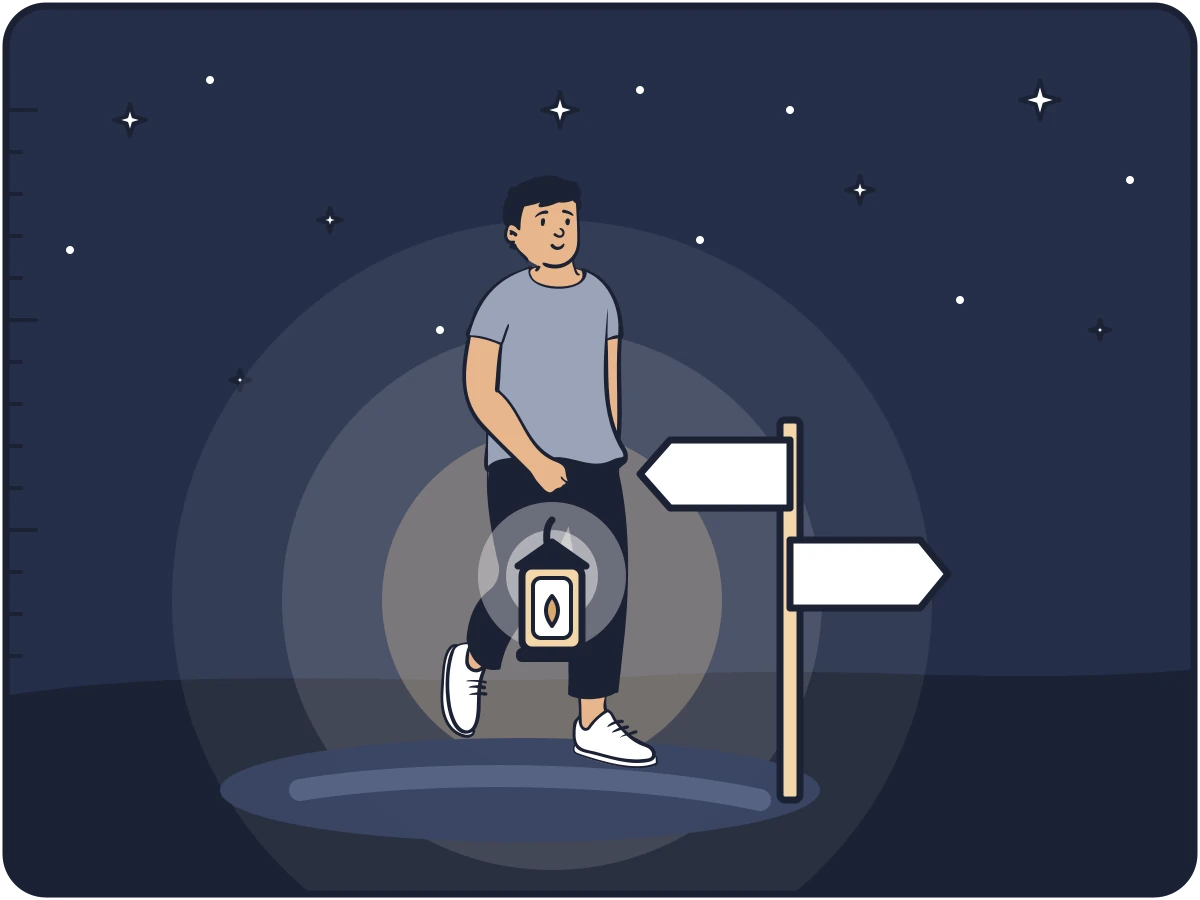
Dev is 25. On Sunday night he opens his laptop to plan the week and types “what is the point of any of this” into a search box instead. The results include a lot of Carl Jung, mostly quote cards that promise to tell him his purpose.
Jung did write about meaning, and more honestly than the cards. This page gives the lines that are real, with the book and chapter, what he said about a life with no sense in it, how he sounded at the end of his own, and what a 25-year-old can take from that without being promised a purpose. If you would like to see how you describe yourself first, the test takes a few minutes.
What did Jung say is the purpose of life?
He never gave one purpose to adopt. The closest he came is a line from Memories, Dreams, Reflections: the sole purpose of human existence, as far as we can see, is “to kindle a light in the darkness of mere being”. For Jung, that light is consciousness: becoming more aware of what is going on in you and around you.
On the personal question, “what should I do with my life?”, he declined to hand out an answer. A doctor, he said, should not have too fixed an aim for a patient, because “there is no universal recipe for living” (CW 16 §81). When patients asked what to do, he wrote that he did not know either (CW 16 §84).
So Jung is not a source of a purpose. He is a source of a way to look for one, and of some strong opinions about what happens if you stop looking.
What is the "kindle a light" line, and do the cards get it right?
Almost. The real sentence is in the chapter “On Life after Death”. Cards often add words: “a light of meaning” is a common one. Jung’s sentence has no “of meaning” in it.
“to kindle a light in the darkness of mere being”
The sentences before it say what he means. Man’s task, he writes, is to become conscious of the contents that rise up from the unconscious, which is the part of the mind you are not aware of but that still shapes what you do. We should neither stay unconscious nor simply be identical with those contents, because that would be evading our destiny, “to create more and more consciousness”.
It is a quiet idea. It does not say “find your calling” or “change the world”. It says that part of what a life is for is noticing, and Jung adds that this noticing may also affect the unconscious in return. It is worth saying that he calls this “as far as we can discern”, which is a hedge, not a command.
Did Jung think a life without meaning is a problem?
Yes, and he was blunt about it. In “Late Thoughts”, a chapter he wrote himself, he says that “meaninglessness inhibits fullness of life”, and that meaning “makes a great many things endurable”, perhaps everything. He calls the lack of it equivalent to illness. Read that as his clinical view of what the lack costs, not as a diagnosis of anyone reading this page.
In his clinical work he saw it in the people who came to him. About a third of his cases, he wrote, had no clinically definable neurosis and suffered from “the senselessness and aimlessness of their lives”, which he called the general neurosis of the age (CW 16 §83).
A caution for Dev. That group was a clinical sample, and Jung says fully two thirds of his patients were in the second half of life. He was not describing 25-year-olds, and he did not say that every Sunday-night dread is a crisis of meaning. Feeling lost in your twenties covers why, and Jung’s stages of life covers what he thought changes later.
Is individuation the purpose of life?
Many pages say so, and they are close but not exact. In Psychology and Alchemy Jung writes that every life is the realisation of a whole, “a self”, that this realisation can be called individuation, and that only the realisation of an individual destiny “makes sense of life” (CW 12 §330).
He then adds a sentence the cards leave out. The “sense” of a life is often something you could as well call “nonsense”, because there is a gap between the mystery of existence and what we can understand. “Sense” and “nonsense”, he says, are man-made labels that give us a reasonably valid direction.
That is an unusual way to talk about purpose: it is a direction you can use, and it comes with an admission that you cannot prove it. What individuation actually involves, and why Jung said most people should not try the deeper steps, is in the individuation article.
What did Jung say about meaning at the end of his life?
Two passages, and neither is triumphant. In the chapter “On Life after Death” he writes that “the meaning of my existence is that life has addressed a question to me”, or the other way round, that he is himself a question put to the world and has to give his own answer.
In the last chapter, “Retrospect”, he is less sure. He says that whether you think the world is mostly meaning or mostly meaninglessness is a matter of temperament. His own view: “Life is or has meaning and meaninglessness”, and he writes that he cherishes “the anxious hope that meaning will preponderate and win the battle”. A little earlier he says there is nothing he is quite sure about.
One caution about the source. Memories, Dreams, Reflections was recorded and edited by Aniela Jaffé, and her introduction lists the chapters Jung wrote himself. “On Life after Death” and “Retrospect” are not on that list, though “Late Thoughts” is. We quote them as Jung’s thought as recorded in a book he approved, not as his own prose.
What we like about these pages is that a man who spent his life on this question did not claim to have settled it. For a 25-year-old that is permission, not a letdown.
Which purpose-of-life quotes are really Jung's?
| The line on the card | What we found |
|---|---|
| "The purpose of life is to kindle a light of meaning in the darkness of mere being" | Close. The real sentence says “the sole purpose of human existence” is “to kindle a light in the darkness of mere being”, with “as far as we can discern” in front. No “of meaning”. |
| "The meaning of my existence is that life has addressed a question to me" | Real. Memories, Dreams, Reflections, “On Life after Death”. |
| "I am not what happened to me, I am what I choose to become" | We found no source in Jung. The nearest real line is “I happen to myself” (CW 11 §391), about the ego and the self, and Jung calls it only “half the psychological truth” because we also feel free. We do not use the card. |
| "Individuation is the purpose of life" | Not in those words. He ties individuation to making sense of a life (CW 12 §330) and also calls the sense a man-made label. |
What can you take from this at 25?
Not a purpose. Jung would have been the first to say he could not supply one. What you can take is a way of asking, and a few small checks.
- Swap the question. “What is my purpose?” asks for an answer. Jung’s version, “what question has life put to me?”, asks what keeps coming back. Write down the three things you keep returning to even when nobody is paying you or watching.
- Keep a two-week log of full and flat. Each evening, one line: when did today feel full, when did it feel flat? Do not analyse yet. After two weeks, read the lines in a row. His phrase for what is at stake is “fullness of life”.
- Do not wait for meaning to arrive first. For a young person still building a footing, Jung’s advice is to shape the ego and educate the will (CW 16 §109), meaning get things done and learn to follow through. Meaning has a way of showing up in work you finish.
If the flat feeling is heavy, has lasted weeks, or is getting in the way of sleep, work or friendships, please talk to a doctor or a counsellor. Jung wrote about meaning as a thing to look for, not as a replacement for help.
Quick answers on Jung and meaning
Did Jung believe life has a meaning?
He leaned that way but said he was not sure. His wording: life “is or has meaning and meaninglessness”, and he hopes meaning wins (Memories, Dreams, Reflections, “Retrospect”).
Can a quiz tell me my purpose?
No. Ours asks how you describe yourself across Jung’s four functions, and the method page says what that can and cannot show. It is not a calling finder.
Sources
- C. G. Jung, Memories, Dreams, Reflections, recorded and edited by Aniela Jaffé, translated by Richard and Clara Winston (Vintage, revised edition): Introduction; chapters “On Life after Death”, “Late Thoughts”, “Retrospect”
- C. G. Jung, “The Aims of Psychotherapy”, in The Practice of Psychotherapy (Collected Works vol. 16, Hull translation), §§81, 83-84, 109
- C. G. Jung, Psychology and Alchemy (CW 12), §330
- C. G. Jung, “Transformation Symbolism in the Mass”, in Psychology and Religion: West and East (CW 11), §391
- Find a Helpline: free, confidential support lines by country