What Did Jung Mean by Introversion and Extraversion?
A direction of interest, not a volume knob, and why Jung never used the word ambivert
7 min read · Updated 28 November 2026
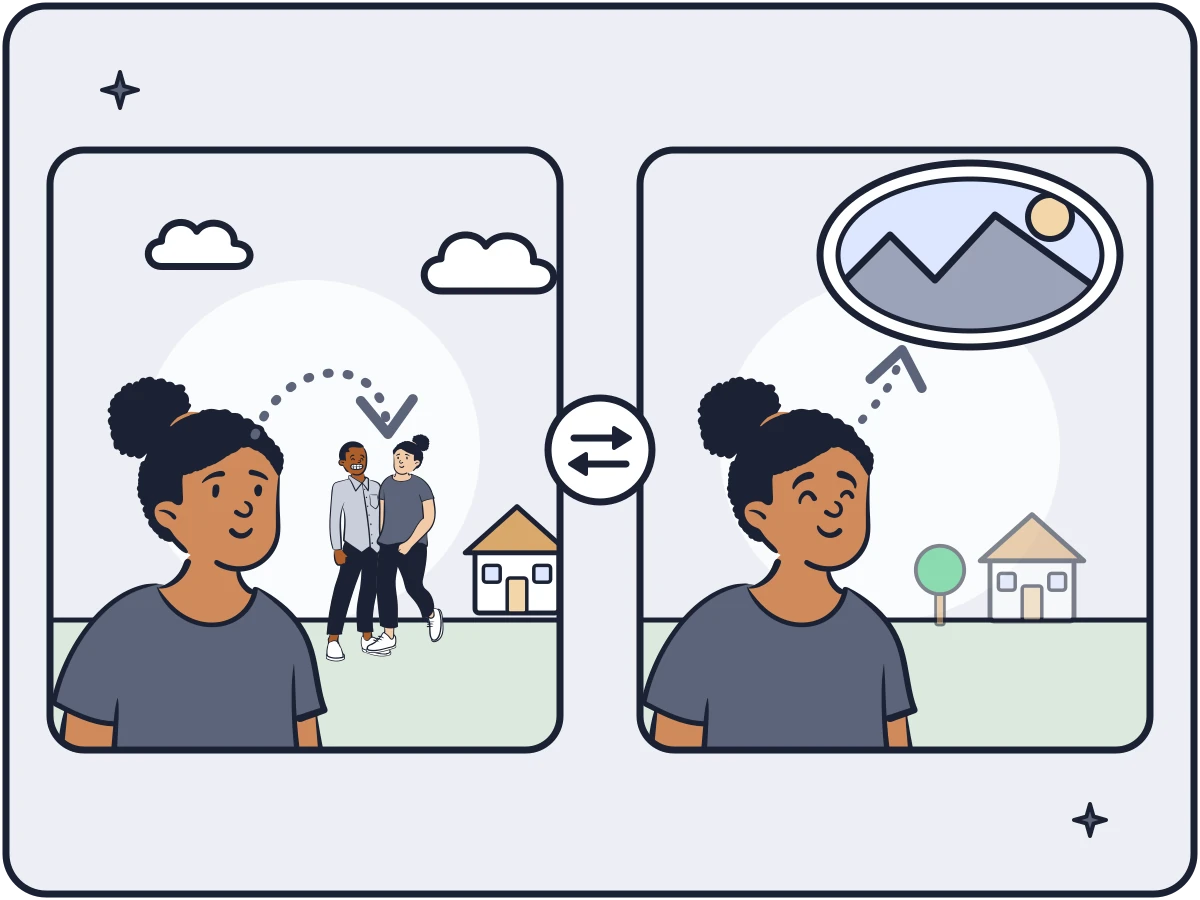
Lena is a month into her first proper job. On Friday she talks to half the office at the pub and goes home glowing. On Monday her manager offers her a bigger role, everyone tells her to take it, and she says no, because something in her says not yet.
By the party-stamina test she is outgoing. By Jung’s test her decision leaned inward. This page sets out what Carl Jung meant by the two words, with paragraph numbers from his Collected Works, and what the popular versions left out. If you want to see which way your own interest tends to point, the test takes about 6 minutes, has no sign-up and gives a free result.
What is the difference between introversion and extraversion in Jung's psychology?
Extraversion means your interest turns outward, toward people, events and things. Introversion means it turns back toward the subject: your own reactions, ideas and inner pictures. Jung called both of them attitudes, meaning a habitual way of facing the world. They name a direction, not a volume.
His textbook definitions are short. Extraversion is “a positive movement of subjective interest towards the object” (CW 6 §710), and in it the pull of the object is “strong, if not exclusive” (§710). In introversion “the subject is the prime motivating factor” and “the object is of secondary importance” (§769).
| Extraversion | Introversion | |
|---|---|---|
| Where interest points | Toward the outer situation: people, events, things | Toward your own reaction: ideas, impressions, inner images |
| What weighs most in a decision | What the situation seems to call for, what others expect | What it means to you, even when the room disagrees |
| Jung's own wording | “strong, if not exclusive, determination by the object” (§710) | “the subject is the prime motivating factor” (§769) |
Back to Lena. Her Friday at the pub shows where her attention went that night. Her Monday shows what carried the most weight when it counted, and that is the question Jung cared about.
Is an introvert just a shy person?
No. Shyness is discomfort around other people, and nothing in Jung’s definitions mentions it. A person can be shy and still pour all their attention outward, or be at ease in a crowd and still trust their own reading over everyone else’s.
Jung’s later portrait does make the introvert look awkward in company. In a 1936 description he writes that the introvert “is not a good mixer” (CW 6 §976) and goes on to a long list of faults. That passage is a sketch of an introvert under strain, in a very different era, and it is not the definition.
In the same book Jung defended the attitude. Calling introverts egocentric, he argued, is “misleading in principle and thoroughly depreciatory” (§621), because the inner side of experience is “as ineluctable a datum as the extent of the sea” (§622). To him, looking inward was one of two normal ways of meeting the world.
How can you tell which way your interest points?
Jung did not watch for party behaviour. His test was motive: when you judge or act, which weighs more, the outer factors or the inner ones (CW 6 §§892-894)?
He gave blunt examples. One type finds a piece of music beautiful “because everybody else pretends it is beautiful” (§892). Another says the weather has turned bad but “in spite of it I shall carry out my plan” (§893).
He also set a rule for finding out: start from the person’s own conscious motives and leave your guesses out of it (§891). So the useful question is not how you look at a party. It is what you actually went by the last time you decided something that mattered.
- Whose opinion did you check first, and did it change your mind?
- When the room disagreed with you, did that feel like information or like pressure?
- When you explain a choice later, do you start with what the situation required, or with what you made of it?
Lena can answer these. Her manager and her friends all read the situation the same way, and she still went by her own sense of it. That is one data point, not a verdict. Jung warned that on this topic your own judgment of yourself is “as a rule extraordinarily clouded” (§3), so ask someone who has watched you decide.
Can you be both? What about ambiverts?
Yes, and Jung said so himself. The two attitudes are “correlative mechanisms”, a going out and a drawing back, and “Every human being possesses both mechanisms” (CW 6 §6). One of them tends to win, and if that becomes habitual you get a type. But “there can never be a pure type” (§6).
He also described a middle group. After the people who are driven mostly from outside and the people driven mostly from inside, there is a third group, and it is “the most numerous”. Its members are “influenced as much from within as from without” (§894).
The word ambivert is not Jung’s. It does not appear in the Collected Works volumes we searched, and it came from later psychologists. What Jung offers instead is the idea that most people are mixed, and that a lean is a tendency, not a box.
Is Jung's extraversion the same as the Big Five trait?
Not quite. The Big Five is a modern research model that measures extraversion as an amount, from low to high. One widely cited analysis splits the trait into two parts: assertiveness (taking the lead) and enthusiasm, which covers sociability and positive mood (DeYoung, Quilty and Peterson, 2007). Both are measures of how much and how visibly.
Jung’s pair asks which way your interest faces, and it does not ask how much of it you have. A very talkative person and a very quiet one can both take their cue from the outer situation. The two ideas overlap, but they are not the same measurement.
A well-known 1989 study, run by Robert McCrae and Paul Costa, compared Jung-based questionnaire scales with Big Five scores. It found that the scales tracked parts of the Big Five, and it concluded that Jung’s theory was “either incorrect or inadequately operationalized” by that questionnaire. For the longer comparison, see Jung’s typology versus the MBTI.
Which popular claims did Jung not make?
| Popular claim | What Jung wrote |
|---|---|
| Introverts are shy. | The definition is about where interest points (§769). Shyness is not in it. |
| Extraverts are the life of the party. | Extraversion is determination by the object (§710). A party is one place it can show, not the definition. |
| You are one or the other. | “Every human being possesses both mechanisms” (§6), and most people sit in a middle group (§894). |
| Introverts are thinkers, extraverts are feelers. | Jung first wrote that, then dropped it as “untenable” (§7; also §836). Each attitude can go with any of the four functions. |
| An introvert recharges alone. | Jung’s definitions do not mention recharging or stamina. |
| Introversion is a flaw to fix. | He treated it as a normal attitude with its own risks, just as extraversion has its own (§§564, 626). |
Did Jung change his mind about the two words?
In one important way, yes. Soon after he published his first formulation, he writes, he “discovered to my dismay” that he had been taken in by it: “I had tried to explain too much in too simple a way” (CW 6 §943). Two classes of people could not account for “the tremendous differences between individuals in either class” (§944), and it took him nearly ten years to settle the doubt.
That is why the four functions exist. The two attitudes are a first, rough cut, not a portrait of a person. Jung also thought the split is “plainly observable” only in a “comparatively well-differentiated personality” (§971), so for many people it is faint.
Lena’s Monday is a fair reminder. One decision tells you something about her, not everything, and Jung would want to see more of her weeks before saying which way she leans.
How do the two attitudes fit with the four functions?
Jung came to see that the attitude is rarely visible on its own. In practice, he found, “no individual is simply introverted or extraverted”, but is so “in one of his functions” (CW 6 §903). That is why he ended up with eight types: each of the four functions, in an inward or an outward form (§913).
So Lena’s Monday is not just “introverted”. In Jung’s terms it is a judgment made inwardly, which is a different thing from taking in impressions in an inward way. There is one page for each pair of portraits, and the first is Jung’s thinking types; the feeling, sensation and intuition pages follow the same pattern.
If the four functions themselves are new to you, start with Jung’s four functions explained.
What happens if you lean too far one way?
Jung’s answer is the same for both. The side you ignore does not disappear. It works in the background and tends to turn up at bad moments, which is the idea behind the inferior function.
He saw a trap in each lean. The extravert can mistake fitting in for being well adapted, and he put it plainly: “Adjustment is not adaptation” (CW 6 §564). The introvert who fights hard for independence ends up, he wrote, with an ego that “becomes enslaved to the objective data” (§626).
These are Jung’s observations from his clinic, not measured findings. If a lean feels painful or stuck in a way that lasts, a qualified professional is the right person to talk to. As a self-check, they are only a prompt to look at real moments, such as one of Lena’s Mondays.
Sources
- C. G. Jung, Psychological Types, Collected Works vol. 6 (Princeton/Bollingen, Hull translation): §§3, 6-7, 564, 575, 621-622, 626, 710, 769, 836, 891-894, 903, 913, 976
- McCrae, R. R., and Costa, P. T. (1989). Reinterpreting the Myers-Briggs Type Indicator from the perspective of the five-factor model of personality. Journal of Personality, 57(1), 17-40.
- DeYoung, C. G., Quilty, L. C., and Peterson, J. B. (2007). Between facets and domains: 10 aspects of the Big Five. Journal of Personality and Social Psychology, 93(5), 880-896.
- The Jungian Test, how the test works and where Jung stops