Jung's Word Association Test: How It Really Worked
100 words, a stopwatch, and the pauses that showed where a person's feelings were
7 min read · Updated 28 November 2026
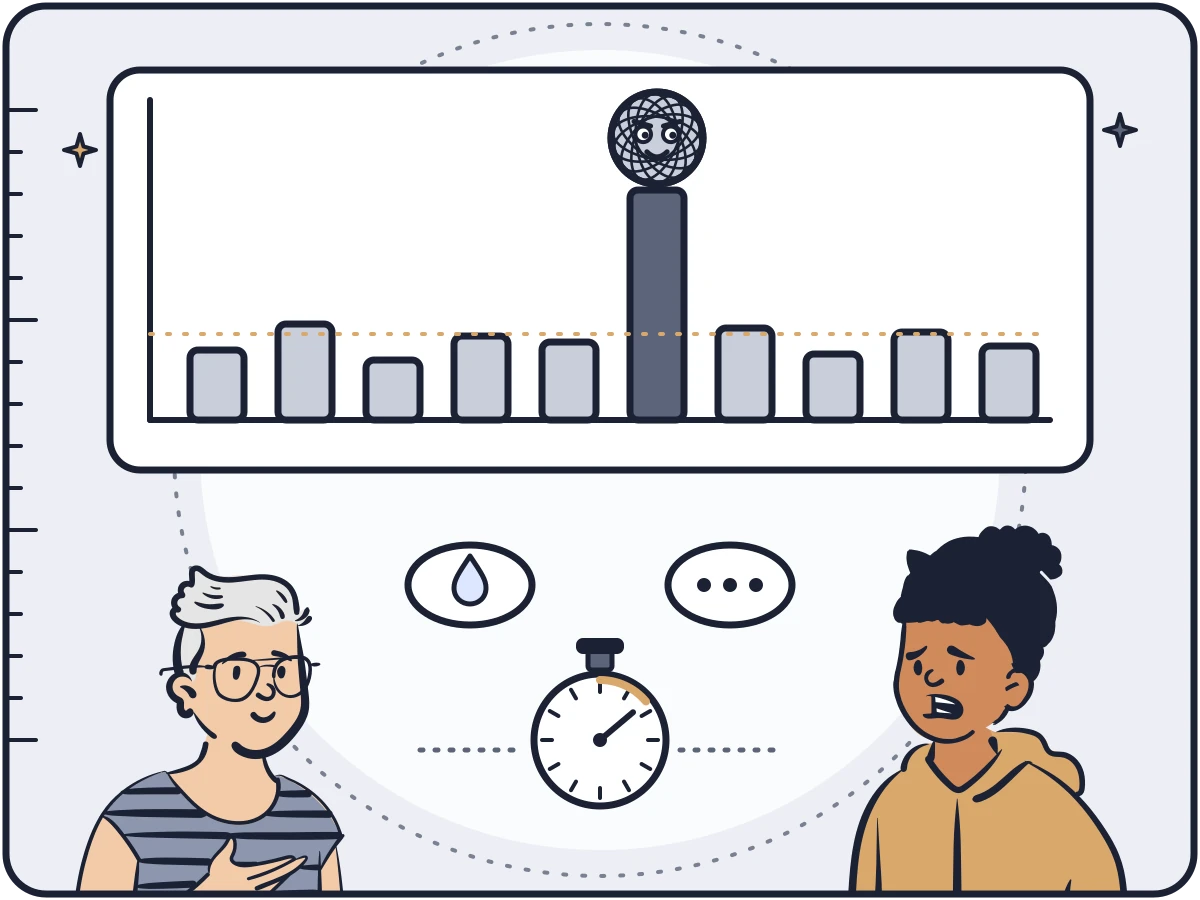
Zoe, 23, is on her phone at lunch. A page promises “Carl Jung’s word association test”, so she types the first word that comes to mind for ten prompts. At the bottom it tells her what her answers say about her unconscious. She wonders whether Jung really did that.
He did something close to the opposite. His version needed an examiner, a stopwatch and a second round, and in his lecture it did not work from a table of meanings. This page shows the real experiment, a sample of his word list, the signs he looked for, a theft he claimed to solve with it, and what an online version cannot do. It also says what our own test is instead.
What was the Jung word association test?
It was a research method, not a personality quiz. An examiner reads out a word, the person answers with the first word that comes to mind, and the examiner times the answer. Jung used it from the early 1900s at the Burghölzli hospital in Zurich, where Eugen Bleuler was the director, and his collaborators included Franz Riklin (CW 2, editorial note).
The idea was not new. The IAAP article on complexes notes that Jung’s group built on Francis Galton’s work on memories linked to words and on Wilhelm Wundt’s work on timing the response. What Jung added was a reading of the pauses.
The results were published between 1904 and 1910 as Studies in Word Association. In their first paper Jung and Riklin used 400 different stimulus words on healthy subjects (CW 2 §8). By 1909, when Jung lectured at Clark University in Massachusetts, he used a set of 100.
What words were on Jung's list?
Here are the first ten of the hundred words as he gave them in that lecture, in English translation: head, green, water, to sing, death, long, ship, to pay, window, friendly (CW 2 §941). Later come to sin, family, lie, to fear, anxiety, to kiss, bride and woman, among others.
The mix is deliberate. The words are chosen, he said, to touch upon almost all the complexes that commonly occur in practice, and they blend nouns, verbs and adjectives.
“so as to touch upon almost all the complexes that commonly occur in practice”
One caution. The English list is a translation, and the editors of the Collected Works say it raised exceptional problems, since a word’s weight in German does not always carry over. The point of a word like “death” or “to sin” was not its dictionary meaning but what it stirs in a particular person.
How was the test run, step by step?
- The instruction. The examiner tells the person to answer as quickly as possible with the first word that occurs to them (CW 2 §943).
- The timing. A stopwatch measuring to a fifth of a second runs from the stimulus word to the answer (CW 2 §12). The examiner writes down both.
- The list. One word after another. The list mixes plain words with ones likely to touch something.
- The recall round. Afterwards the examiner reads the same words again and asks whether the person remembers their earlier answers (CW 2 §991).
- The comparison. Jung compared a person’s reaction times and slips on the loaded words with their own times on the neutral ones. The baseline was always the same person.
That last step is the one online versions drop. A pause only means something if you know how long this person normally takes.
What counts as a sign of a complex?
Jung’s complex is an emotionally loaded cluster that interferes with ordinary replies. In the experiment it shows up as a handful of disturbances. They are not signs of low intelligence: the long pauses were about feeling, he wrote, not about difficulty with language (CW 2 §944).
| Sign | What it looks like | Where Jung describes it |
|---|---|---|
| Long reaction time | A pause well beyond the person’s usual time on neutral words. | CW 2 §944 |
| No answer | The person finds nothing to say, or refuses the word. | CW 2 §946 |
| Too many words | A one-word task turns into explaining or qualifying. | CW 2 §§947-951 |
| Repeating the stimulus word | The person says the prompt back as if it were a hard question. | CW 2 §954 |
| The same answer again and again | One word keeps turning up, even where it makes no sense. | CW 2 §955 |
| Failed recall | In the second round the person cannot remember what they said. | CW 2 §§991-992 |
On recall, Jung reported wrong answers in healthy people seldom above 10 to 15 per cent, against 20 to 40 per cent in some patients (CW 2 §992). His explanation was that one easily forgets what one said under emotion.
Notice what the signs do not do. None of them says what the complex is about. A repeated word can point to something painful, as in his example of a man who kept answering “short” and was in fact the smallest of four brothers (CW 2 §955), but you only learn that by asking the person about their life.
What would the test have shown for Zoe?
Here is an invented run, to show the logic. Zoe’s usual time on neutral words is about a second and a half. The table is made up, and it is not a reading of anyone.
| Word | Zoe's answer | Time | What an examiner would note |
|---|---|---|---|
| head | hat | 1.4 s | Typical. |
| water | glass | 1.5 s | Typical. |
| death | um, long | 4.8 s | Slow, hesitant. Mark it. |
| to sin | (no answer) | 6 s | Blank. Mark it. |
| window | view | 1.3 s | Typical. |
| family | Sunday | 1.7 s | Typical. |
Two words stand out against her own baseline, so those two are worth a look. In the recall round she cannot remember what she said for “death”. That is a pattern across two measures, and it is still not an answer. She might have lost someone this year, or been startled by a noise, or be thinking about lunch.
Jung’s next step would be to talk to her about those two words. Without that conversation a result is a hunch. A page that skips the conversation and prints “your answers show repression” is doing something Jung’s papers do not.
Did Jung really catch a thief with it?
He said so, and he told the story in his 1909 lecture. On 6 February 1908 a nurse at the Burghölzli reported that 70 francs had gone from a purse in her clothes-cupboard. Three nurses were close enough to be suspects (CW 2 §§957-959).
Jung built a list of critical words from the facts of the case, such as the cupboard, the key, the colour of the purse and the amounts, and mixed them with twice as many ordinary words (CW 2 §§960-963). He then ran the test on all three. His first impression, from how they behaved, pointed at the charge nurse, whose reserve struck him as bordering on impudence, and he set out to find her guilty (CW 2 §965).
He then did the sums, and the sums told a different story. He wrote that one must always base one’s judgment on calculation, because appearances are most deceptive (CW 2 §966).
The numbers compared each woman’s reactions on critical and ordinary words. The gap in reaction time, in fifths of a second, was 6 for the charge nurse’s friend, against 2 for the charge nurse and 3 for the third. Her wrong recalls were also the highest, 34 per cent against 28 and 30. That evening she confessed (CW 2 §§968-981).
It is a striking story, and it is one case. Critics had objected that charged words affect an innocent person too. Jung answered that this was a matter for experience, and that the method was worth exploring further (CW 2 §§962, 982). It is a research result from 1908, not a lie detector.
Can you take a Jung word association test online?
You can type words into a web page. Calling that the Jung word association test is like calling a photo of a thermometer a temperature reading, and the gaps are not small.
- No stopwatch and no examiner. Timing was half the method, and a person reading to themselves cannot be surprised by a word.
- No baseline. Without knowing a person’s normal speed, a long answer means nothing.
- No recall round. Failed recall was one of his clearest signs.
- No dictionary of meanings. In the 1909 lecture Jung read answers against the person’s own pattern, and the meaning came from talking with them.
If you want to see what a pause feels like, a parlour version with a friend is harmless. The friend reads twenty plain words, such as head, green, water, ship, window and lamp, times your answers with a phone, then reads them again so you can try to recall your answers. Skip the loaded words, and stop if anything feels heavy.
Treat the result as curiosity about how people differ in speed and wording, and nothing more. If a topic keeps hitting hard in daily life, a professional is the right person to talk to.
How is our test different?
Our test does not use a word list or a clock. It shows a short everyday scene, such as a group chat or a plan that falls through, and asks what you would do. From those choices it ranks Jung’s four functions: thinking, feeling, sensation and intuition.
That makes it a set of questions about how you describe your habits. It cannot reach what you do not know about yourself, which Jung said includes complexes you would deny (CW 2 §983). Our method page explains the scoring and the limits.
More questions about the word association test
Did Jung invent word association?
No. Galton had used words as prompts before him, and Wundt had worked on timing responses. Jung’s contribution, with Riklin, was to read the disturbances as a sign of emotional complexes.
Is the word association test accurate?
This page does not judge its validity. Jung reported it as a research tool and, in the theft case, as a pointer rather than proof (CW 2 §982). Treat anything that claims to read your unconscious from ten typed words with doubt.
Sources
- C. G. Jung, Experimental Researches (Collected Works vol. 2, Hull translation): editorial note; “The Associations of Normal Subjects” (with Franz Riklin) §§8, 12; “The Association Method” §§939-992
- C. G. Jung, “The Association Method”, American Journal of Psychology (1910), trans. A. A. Brill; public domain text of the 1909 Clark University lectures
- C. G. Jung (ed.), Studies in Word-Association, trans. M. D. Eder (1918), the translated 1904 to 1910 series
- Nancy Krieger, “The Theory of Complexes”, short articles on analytical psychology, International Association for Analytical Psychology